
EPA Security Rule Hits Soil Moisture Sensor Imports
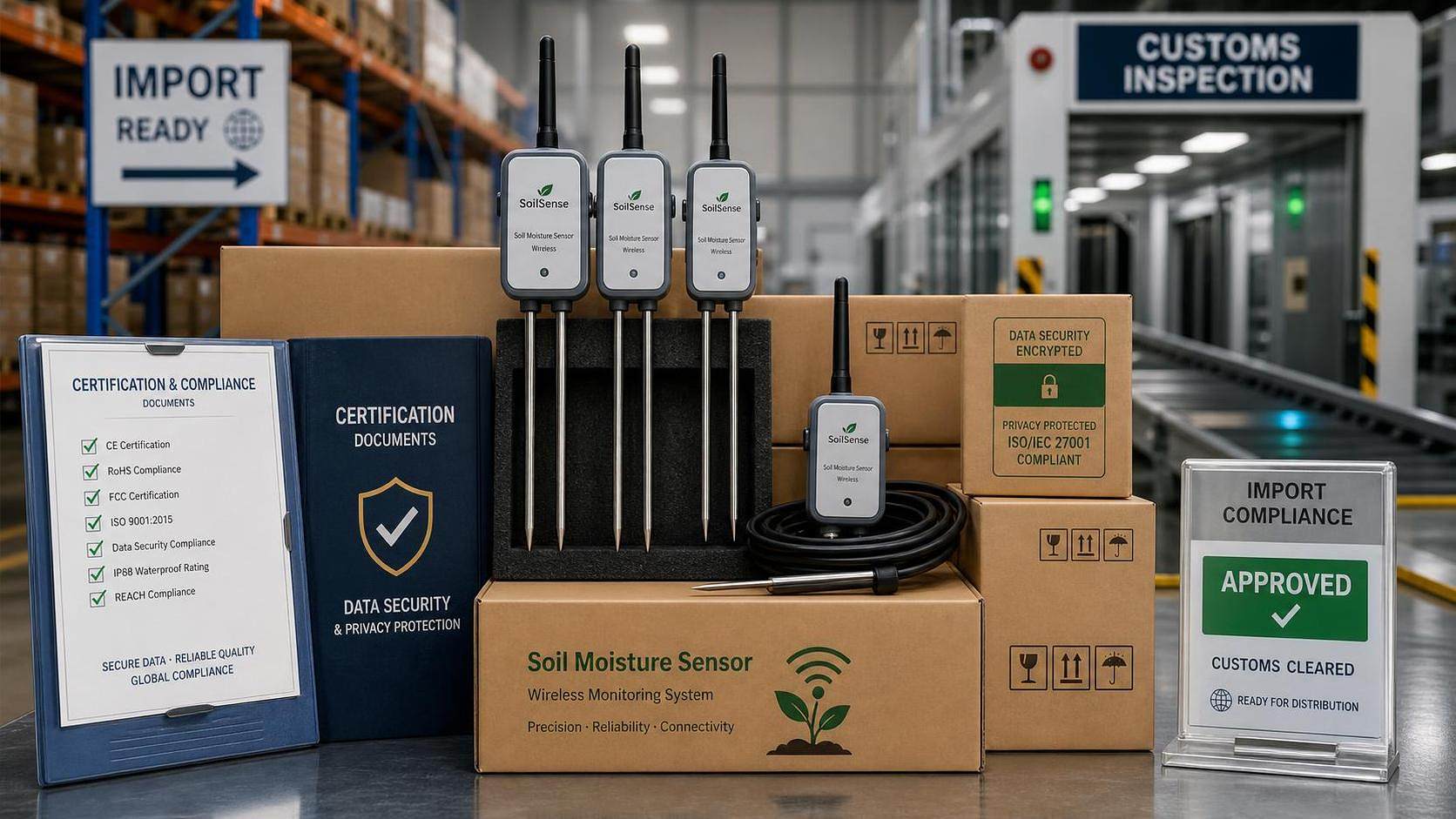




On August 1, 2026, a new compliance threshold took effect for soil moisture sensors entering the U.S. market. The trigger was an EPA enforcement notice issued on July 22, 2026, requiring imported soil moisture sensors to meet EPA Tier 3 IoT data security certification under 40 CFR Part 195. For manufacturers, importers, and supply chain participants tied to U.S.-bound shipments, the development matters because it moves data security from a product feature issue into an import access requirement, with customs rejection and importer liability now directly tied to certification status.
What the rule now requires at the border
According to the information provided, the U.S. Environmental Protection Agency issued a mandatory enforcement announcement on July 22, 2026. Starting August 1, 2026, all soil moisture sensors imported into the United States must obtain EPA Tier 3 IoT data security certification under 40 CFR Part 195.
The stated certification scope includes wireless communication encryption, a local data erasure mechanism, and audit logs for remote firmware updates. The same notice indicates that products without the required certification will be denied entry by CBP. It also states that importers may face retroactive joint liability linked to non-compliant imports.
Where the pressure falls across the supply chain
Export-facing manufacturers now face a market access checkpoint
From an industry perspective, manufacturers producing soil moisture sensors for the U.S. market are the first group directly affected. The impact is concentrated in export compliance, product configuration, certification readiness, and shipment release. What deserves closer attention is whether a product intended for U.S. import can demonstrate conformity to the required security items before goods reach the port of entry.
Importers and trading companies carry direct transaction risk
For importers and direct trading entities, the issue is not limited to product selection. The enforcement notice ties non-compliance to CBP refusal at the border and to importer-side liability exposure. Analysis shows that this puts greater weight on supplier qualification, document review, and pre-shipment confirmation, especially where products are sourced from overseas manufacturers.
Supply chain and delivery coordination may become tighter
Supply chain service providers, including those involved in cross-border coordination and delivery execution, may also be affected in practical terms. Observably, any uncertainty around certification status can influence customs clearance, scheduling, and delivery commitments. The business focus here is less about policy interpretation alone and more about whether compliance evidence is ready when cargo moves.
Downstream buyers may need stricter procurement checks
Procurement teams and end-use buyers connected to U.S.-bound projects should also pay attention. Analysis shows that the new requirement may affect supplier screening, contract confirmation, and acceptance planning, because a product that cannot lawfully enter the U.S. market creates immediate supply continuity risk regardless of its technical suitability in application.
What companies should watch now
Confirm whether product scope and certification status align
The most immediate task is to verify whether the soil moisture sensors being shipped or ordered for the U.S. market fall within the announced requirement and whether EPA Tier 3 IoT data security certification has actually been obtained. In practice, this is a threshold question for shipment planning and customer commitments.
Review the security elements named in the notice
Companies should focus closely on the specific compliance elements identified in the announcement: wireless communication encryption, local data erasure capability, and audit logging for remote firmware updates. What deserves closer attention is the difference between having internal technical functions and having those functions recognized within the required certification framework.
Recheck documents, importer responsibilities, and communication flow
Because the notice links non-compliance to both border refusal and importer liability, firms involved in ordering, exporting, and importing should review how certification-related documents are prepared, shared, and retained. Analysis shows that gaps in paperwork or in supplier-to-importer communication could become as important as the product status itself during execution.
Track official wording for any further clarification
Although the enforcement date is clear in the provided information, companies should continue monitoring how the requirement is described in official materials and in transaction-level implementation. Observably, the operational impact often depends on how certification proof, audit records, and product classification are checked in real trade flows.
Why this looks bigger than a one-off shipment issue
Analysis shows that this development should not be read only as a narrow customs event. It indicates that, for this product category, IoT security controls are being treated as a condition of lawful market entry into the United States. That changes the practical importance of device-side security features for exporters and importers alike.
At the same time, it is more appropriate to understand this as a confirmed compliance requirement for the stated effective date, rather than as a fully settled long-term market outcome. The immediate rule is clear from the provided information, but the broader commercial response across sourcing, certification planning, and customer requirements still needs continued observation.
How the market is likely to read this development
The most grounded reading is that the August 1, 2026 effective date creates an immediate operational compliance checkpoint for soil moisture sensor imports into the U.S. market. For affected businesses, the issue is not abstract policy direction but whether products, documents, and importer responsibilities are aligned before shipment reaches the border.
From an industry perspective, this is both a short-term execution issue and a longer-term signal. In the short term, it affects admissibility and delivery risk. Over the longer term, it suggests that product security requirements may carry greater weight in cross-border market access decisions for connected devices. That wider implication still requires ongoing observation rather than a fixed conclusion.
Basis of this article and points still to verify
This article is based on the user-provided news title, event date, and event summary concerning the EPA enforcement notice, the August 1, 2026 effective date, and the stated Tier 3 IoT data security requirements for imported soil moisture sensors. For this type of industry update, relevant source categories would usually include official government notices, company disclosures, industry association updates, authoritative media reporting, and standard or regulatory documents.
A specific official source link was not provided in the input, so the precise document trail should still be verified on an ongoing basis. What deserves continued attention is any further official clarification on implementation wording, certification proof requirements, and how enforcement is reflected in actual import processing.
Related News
Agricultural Product Information Market Guide: Key Data for Sourcing Decisions
Agricultural product information market guide for smarter sourcing—compare machinery, irrigation, precision tools, lifecycle costs, and supplier risk.
Large-Scale Farm Equipment Cost Comparison: Price, Fuel, and Lifecycle Value
Large-scale farm equipment cost comparison: evaluate price, fuel, maintenance, downtime, and lifecycle value to choose tractors, combines, irrigation, and smart tools with confidence.

A Procurement Specification Preparation Example for Buying Farm Equipment
Procurement specification preparation example for farm equipment: learn to define requirements, compare suppliers, control lifecycle costs, and buy with confidence.
How Does Climate-Smart Farming Reduce Water Use in Semi-Arid Areas?
How does climate-smart farming reduce water use in semi-arid zones? Discover precision irrigation, soil monitoring, and smarter crop planning for resilient yields.
Can Sustainable Farming Be Profitable Without Reducing Yields?
Are sustainable farming practices profitable without yield loss? Discover precision strategies that cut waste, protect yields, and improve farm margins.
What Are the Risks of Switching to Climate-Smart Farming Mid-Season?
What are the main risks of switching to climate-smart agriculture mid-season? Explore yield, irrigation, equipment, cost, and labor risks with practical steps for safer adoption.

How to Choose Plant Protection Equipment for Vineyard Pests
How to choose the right plant protection equipment for vineyard pests: compare sprayers, nozzles, precision tools, drift control, and canopy coverage for smarter vineyard protection.
What Is the Difference Between No-Till and Conventional Tillage?
What is the difference between no-till and conventional soil preparation? Compare residue management, costs, erosion control, equipment, and planting performance.

Does No-Till Farming Reduce Erosion on Hilly Farmland?
Does no-till soil preparation reduce erosion on hilly farmland? Discover how residue cover, soil structure, cover crops, and runoff management protect slopes.
Related News
- 00
0000-00
How Does Climate-Smart Farming Reduce Water Use in Semi-Arid Areas? - 00
0000-00
USDA Rule Takes Effect: Dual FCC and NRCS Approval for Soil Moisture Sensors - 00
0000-00
EU Rule Takes Effect: Soil Moisture Sensors Need Revised CE-EMC Certification - 00
0000-00
How to Choose Wireless Smart Irrigation Systems for Better Water Control - 00
0000-00
How to Choose Wireless Soil Moisture Sensors for Irrigation and Field Monitoring
Popular Tags
Hydrological Resource Strategist
Weekly Insights
Stay ahead with our curated technology reports delivered every Monday.