
Does No-Till Farming Reduce Erosion on Hilly Farmland?
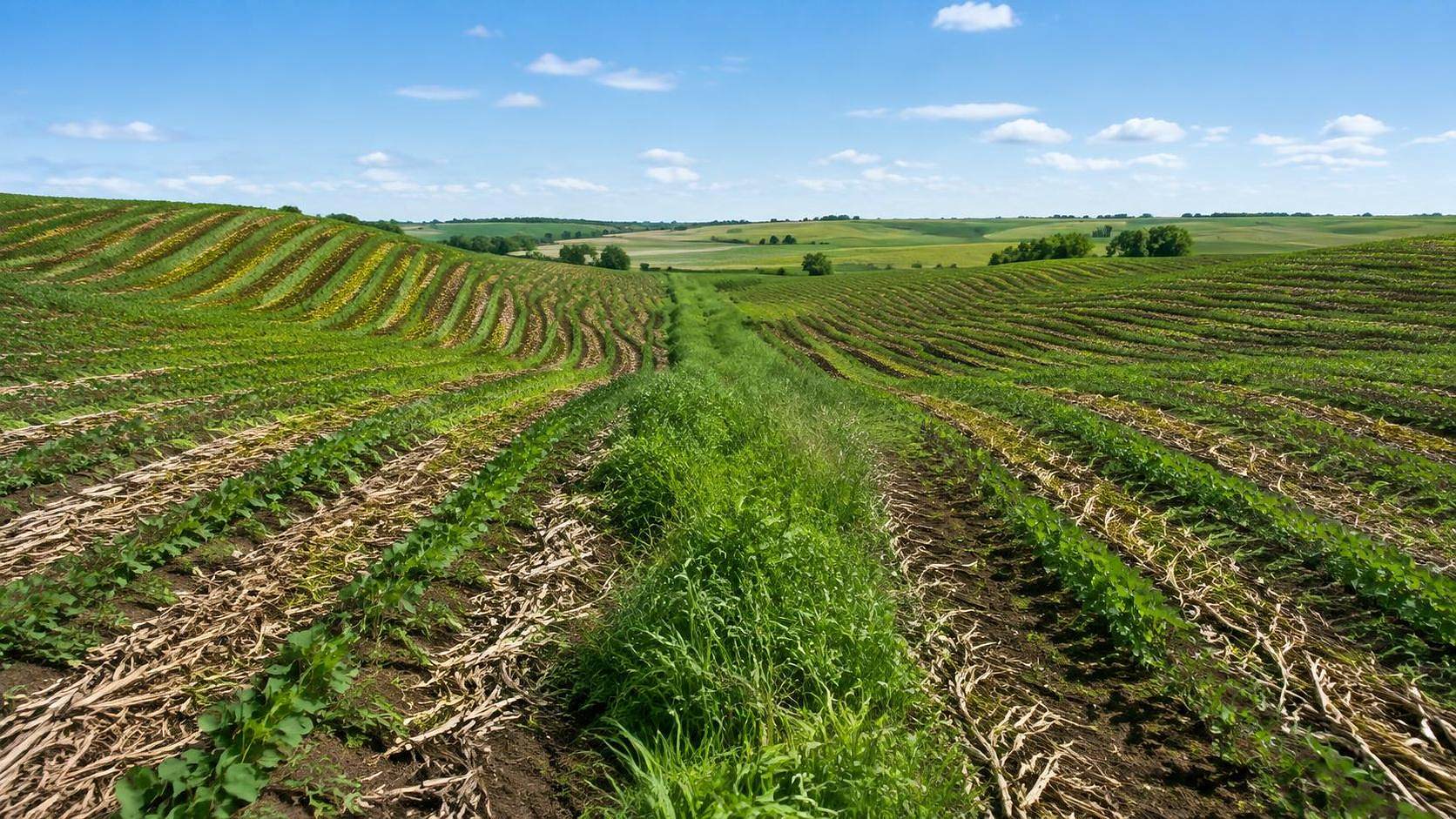




Yes. No-till farming can substantially reduce erosion on hilly farmland when it leaves enough residue on the surface, preserves stable soil structure, and prevents concentrated water flow. It is not an automatic cure for every slope. A no-till field with poor residue cover, compacted wheel tracks, or runoff moving through gullies can still lose soil during intense storms. The erosion benefit comes from the whole field system: crop residue, infiltration, traffic patterns, planting direction, drainage, and the condition of the soil beneath the surface.
On sloping land, rainfall does more damage when water gathers speed and carries detached soil downhill. Conventional soil preparation often leaves a smooth, loose surface with limited protection between crop rows. Raindrops can break apart exposed aggregates, seal the soil surface, and create shallow sheets of moving water. As water converges, sheet erosion can become rill erosion, then develop into channels that require repair before the next crop.
No-till changes the starting conditions. Standing stalks, chopped residue, and an undisturbed surface absorb some raindrop energy and slow water at the soil surface. Root channels and biological pores can improve water entry when they remain open. Over repeated seasons, less mechanical disturbance can support aggregate stability and organic matter near the surface. These effects give rainfall more time to infiltrate instead of flowing down the slope.
Why residue cover matters more than the no-till label
A field is not protected merely because a planter was used without prior tillage. Surface cover is the first visible defense against erosion. Residue intercepts rainfall, reduces splash, roughens the flow path, and traps sediment moving between rows. Bare strips left by harvesting, grazing, residue removal, or aggressive residue sizing can weaken that defense quickly on a slope.
Crop type and harvest method strongly influence the result. Corn stalks usually provide durable cover through much of the erosion-prone period, while finely chopped soybean residue breaks down faster and leaves less physical resistance to runoff. Small-grain residue can protect the soil well after harvest, but its value falls if it is incorporated or removed before the next rainy season. Cover crops extend protection when the cash-crop residue alone is thin, especially on fields that remain exposed for months.
The distribution of residue matters as much as the total amount. A combine that concentrates straw in a narrow band creates protected and unprotected zones. Uneven spread patterns are especially harmful where runoff follows the same low areas year after year. Chaff and straw spreaders should cover the full cutting width, and their pattern should be checked under actual wind conditions rather than judged only on level ground near the field entrance.
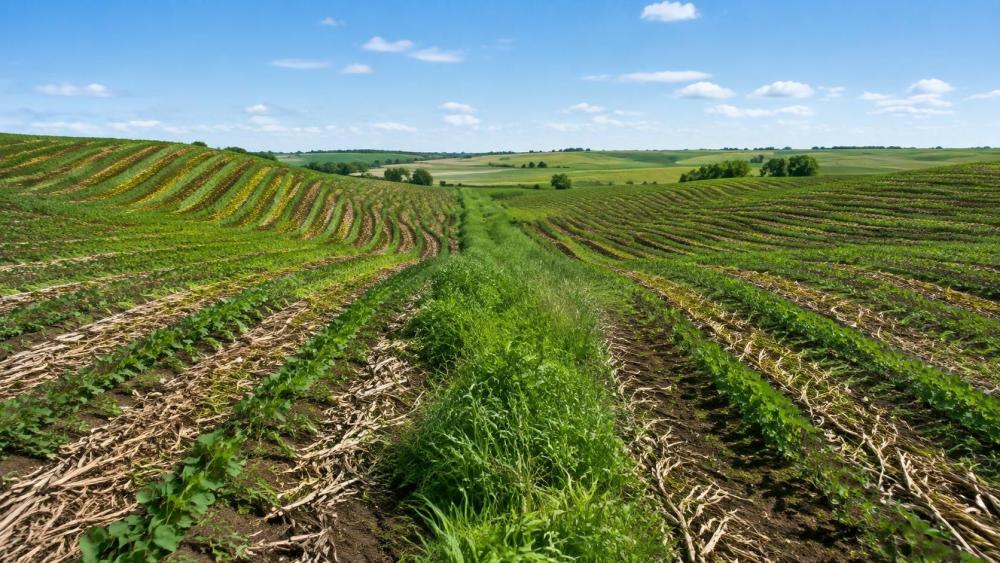
Residue can also be displaced by planting equipment. Row cleaners set too aggressively may create bare, smooth channels that connect downslope. Clearing only enough material to establish seed-to-soil contact usually causes less exposure than sweeping a wide path. On steep or irregular slopes, a row unit that follows the ground accurately is less likely to scalp residue from ridges while leaving excessive material in depressions.
Slope length changes the erosion risk
Steepness attracts attention, but slope length often determines whether runoff becomes destructive. Water flowing down a short slope has less opportunity to accumulate. The same gradient extending across a long field can produce much greater flow volume near the lower end. No-till reduces the force of runoff, yet it cannot always keep water dispersed across an uninterrupted long slope during a high-intensity storm.
Topography should therefore guide field design. Contour planting, where practical, interrupts direct downhill flow and gives water a longer, slower path. Grassed waterways protect established drainage routes where runoff naturally concentrates. Diversions, terraces, strip crops, or contour buffer zones may be necessary where slope length and water convergence exceed what residue cover can manage alone. These are not signs that no-till has failed; they address a different problem: managing water after it has collected.
A useful distinction is between diffuse runoff and concentrated flow. Diffuse runoff spreads broadly across the surface and is often reduced by residue, roughness, and infiltration. Concentrated flow follows a wheel track, planter furrow, headland depression, terrace outlet, or natural swale. It can cut through a well-managed no-till field because the amount of moving water becomes too large for surface cover alone. Repairing the visible channel without locating its upstream source commonly leads to repeated damage.
Soil structure determines whether water enters or escapes
No-till tends to improve infiltration only when the soil can receive water. Stable aggregates, continuous pores, earthworm channels, decayed roots, and a surface that has not sealed all support infiltration. The benefit develops over time and can be interrupted by compaction, poor drainage, or repeated traffic in wet conditions.
Compacted areas are a frequent reason for disappointing no-till results on hillsides. Heavy loads can compress the surface or form a denser layer below the planting depth. Rain then ponds or runs laterally above the restriction, often emerging downslope as saturated soil or rills. The field may appear to have adequate residue, yet water is being rejected by the profile rather than slowed by the surface.
Compaction should be diagnosed before adding aggressive tillage. Digging across a suspected zone can reveal abrupt changes in root direction, dense layers, smeared soil, or shallow water movement. Penetrometer readings can add context, but a single resistance value does not explain the full condition; soil moisture at the time of measurement affects the reading. Comparing compacted wheel lanes with adjacent uncrowded soil, observing root depth, and tracking where runoff begins provide a more useful picture.
Targeted remediation is sometimes justified, particularly where a confined traffic route has created a persistent restriction. Broad deep tillage across an entire hillside can remove residue, disturb protective pores, and leave soil more vulnerable during the period when it most needs cover. When loosening is necessary, timing, depth, surface protection, and a plan to prevent re-compaction matter more than treating the pass as a permanent fix.
Equipment practices can preserve or undo the erosion benefit
No-till equipment is often discussed in terms of emergence and field capacity, but on rolling ground its setup also affects runoff. Openers that cut a narrow, consistent seed slot disturb less soil than systems that throw loose earth to the side. Downforce should be sufficient to maintain planting depth without pressing the sidewalls into a dense, polished slot. Excess downforce can be tempting in firm soil, yet it may worsen compaction and limit early root movement where soil is wet.
Closing systems deserve similar attention. A slot that remains open can dry rapidly and expose seed, while an over-compressed slot may form a dense seam that restricts roots and water. Conditions change within a single hilly field: ridge tops may be dry and firm while lower positions remain moist. Fixed settings that work at the top may be too aggressive in the lower area. Variable downforce, sensor feedback, and frequent field checks can reduce those differences, but the underlying goal remains simple: place seed consistently while disturbing and compacting as little soil as practical.
Traffic planning has an outsized effect on sloping ground. Repeated passes in the same track create predictable flow paths. Controlled traffic can confine compaction to permanent lanes, provided those lanes are not oriented to deliver water directly downhill. Headlands need special scrutiny because turns, loading, and repeated passes frequently reduce infiltration there. A compacted headland at the upper edge of a field can shed water into cropped ground below.
- Harvest traffic: Avoiding travel on wet soil protects pore space that no-till relies on. Ruts should be addressed before they become channels for spring runoff.
- Residue management: Spreaders, chopping settings, and header height should leave a reasonably even protective layer rather than dense windrows beside bare lanes.
- Planter attachments: Coulters, row cleaners, fertilizer openers, and closing wheels should be evaluated as one disturbance system, not as separate accessories.
- Sprayer and grain-cart routes: Where terrain permits, routes should avoid repeatedly crossing drainage swales or creating long uninterrupted wheel tracks down the grade.
Rainfall timing can expose weak points
No-till offers its greatest erosion protection when residue remains in place before erosive rainfall arrives. A field planted into cover but left bare after a late harvest may be vulnerable during the interval before establishment. Likewise, termination timing for a cover crop changes the balance between moisture use, planting conditions, and living or dead surface cover. There is no single termination date that fits all soils, crops, and weather patterns.
Frozen or saturated soil creates another limitation. When the soil profile cannot absorb water, even high residue cover has a reduced ability to prevent runoff. Residue still slows flow and traps sediment, so it remains valuable, but water must be managed at the landscape scale. Snowmelt paths, frozen-wheel-track runoff, and drainage outlets should be assessed separately from summer thunderstorm erosion.
Heavy rainfall can also reveal a misleading success signal. A no-till field may show little visible sediment at the bottom of the slope because residue has captured soil particles, while water still leaves through a concentrated outlet. The absence of a muddy wash does not prove that infiltration was high. Looking for standing water, sediment deposited behind residue, fresh rills, damaged outlets, and changes in drainage timing gives a more complete assessment.
Cover crops strengthen no-till where residue is short-lived
Cover crops can provide living roots during periods when a harvested cash crop would leave the soil exposed. Their canopy reduces raindrop impact, and their roots reinforce the near-surface soil while creating pathways for water. Species choice should fit the intended planting window, residue needs, moisture conditions, and termination method. A cover that establishes unevenly on dry ridge tops may protect low positions well while leaving the most exposed ground thinly covered.
Seeding method affects erosion performance. Broadcast seed placed just before a reliable rainfall may establish adequately in some situations, but poor seed-to-soil contact can leave patchy cover. Drilling usually places seed more consistently but adds traffic and may disturb residue if poorly adjusted. Interseeding into a standing crop can extend the establishment window, though shading and moisture competition affect the outcome. The relevant question is not whether a cover crop was seeded; it is whether enough living or dead material protected vulnerable ground when runoff risk was highest.
Field observation should follow water, not just crop rows
Assessing hillside erosion after each major runoff event is more informative than relying on a single annual inspection. Start near the upper boundary and trace where water enters, crosses, concentrates, and exits. Note changes in residue cover, tire depressions, shallow channels, sediment fans, exposed roots, and blocked waterways. Repeat observations under different rainfall directions because wind-driven residue movement and rainfall patterns can shift the weak point.
Elevation maps, yield maps, planting records, and machinery guidance lines can help identify recurring patterns. They should be interpreted alongside field inspection. A low-yield strip may result from erosion, shallow soil, compaction, nutrient movement, poor drainage, or a combination of these conditions. Treating every weak-yield area as an erosion problem can lead to unnecessary tillage or drainage work.
No-till soil preparation reduces erosion on hilly farmland most reliably when it is used as a protection-and-water-management system rather than a single planting method. Keep the surface covered, maintain soil porosity, limit downslope traffic channels, and intercept concentrated water where terrain requires it. Those measures protect the soil during the storms that test the system most severely.
Related News
Agricultural Product Information Market Guide: Key Data for Sourcing Decisions
Agricultural product information market guide for smarter sourcing—compare machinery, irrigation, precision tools, lifecycle costs, and supplier risk.
Large-Scale Farm Equipment Cost Comparison: Price, Fuel, and Lifecycle Value
Large-scale farm equipment cost comparison: evaluate price, fuel, maintenance, downtime, and lifecycle value to choose tractors, combines, irrigation, and smart tools with confidence.
A Procurement Specification Preparation Example for Buying Farm Equipment
Procurement specification preparation example for farm equipment: learn to define requirements, compare suppliers, control lifecycle costs, and buy with confidence.
What Are the Risks of Switching to Climate-Smart Farming Mid-Season?
What are the main risks of switching to climate-smart agriculture mid-season? Explore yield, irrigation, equipment, cost, and labor risks with practical steps for safer adoption.
How to Choose Plant Protection Equipment for Vineyard Pests
How to choose the right plant protection equipment for vineyard pests: compare sprayers, nozzles, precision tools, drift control, and canopy coverage for smarter vineyard protection.
What Is the Difference Between No-Till and Conventional Tillage?
What is the difference between no-till and conventional soil preparation? Compare residue management, costs, erosion control, equipment, and planting performance.
What Harvesting Machinery Works Best for Small Grains on Hills?
What harvesting machinery works best for small grain on hilly terrain? Compare hillside combines, compact models, headers, and traction options for safer, cleaner harvests.
How Does Farm Mechanization Affect Food Security in Developing Regions?
How does farm mechanization impact food security in developing regions? Discover how right-sized equipment, service access, and loss reduction build resilient food systems.
Which Implements Are Compatible With a 200 HP Tractor for Mixed Cropping?
What implements are compatible with a 200HP tractor for mixed cropping? Explore practical matches for tillage, drilling, baling, spraying, and hauling.
Related News
- 00
0000-00
What Is the Difference Between No-Till and Conventional Tillage? - 00
0000-00
Does No-Till Farming Reduce Erosion on Hilly Farmland? - 00
0000-00
India BIS Tightens Soil Tiller Labeling for Imports - 00
0000-00
Vietnam Requires Vietnamese Warning Labels for Imported Soil Tillers - 00
0000-00
India BIS Expands Soil Tiller Energy Labels to Electric Imports
Popular Tags
Agri-Mechanization Fellow
Weekly Insights
Stay ahead with our curated technology reports delivered every Monday.