
Rail Route Cuts Drip Irrigation Clearance to 72 Hours
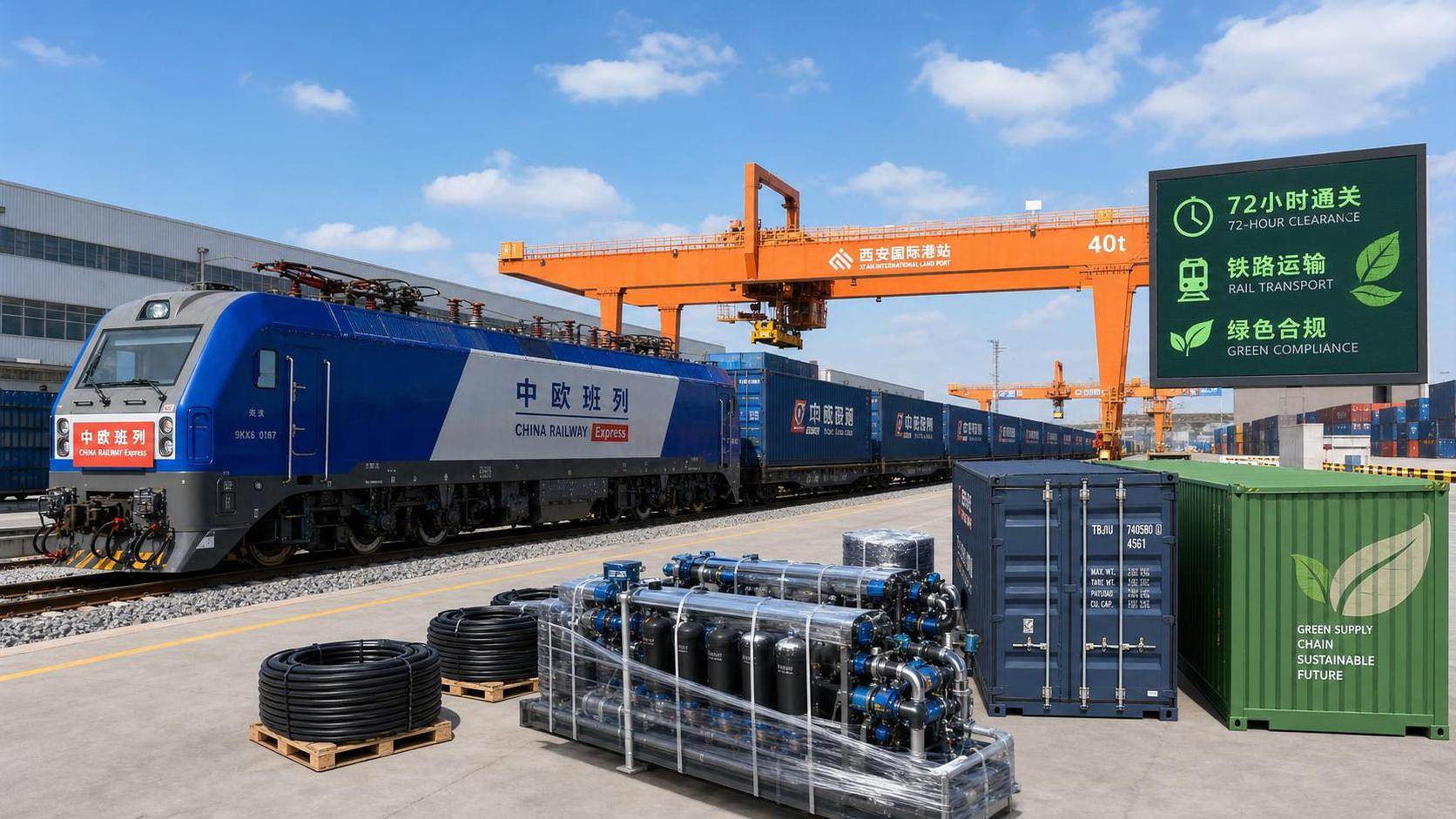




On July 2, 2026, a new China-Europe rail service dedicated to Drip Irrigation Logic smart irrigation equipment was launched with routes linked to Kazakhstan, Poland, and Spain. The practical significance of this development is not only the opening of a transport lane, but the combination of advance declaration, local release, and direct rail transit with a CE-EPD carbon-footprint pre-screening interface. For exporters, buyers, logistics providers, and compliance teams, this is worth watching as a concrete execution signal that customs handling and green compliance preparation may increasingly be managed in parallel rather than as separate steps.
A new execution model is now in operation
According to the provided event summary, the Xi'an International Port District and China Railway Container Transport launched the first dedicated "Drip Irrigation Logic smart irrigation equipment" train on July 2, 2026. The service covers three lines connected to Kazakhstan, Poland, and Spain. The route applies a model described as "advance declaration + local release + direct rail transit," and the full-container customs clearance time has been reduced to within 72 hours.
The same channel has also been connected to an EU CE-EPD carbon-footprint pre-screening interface. This allows Drip Irrigation Logic exporters using the route to complete green compliance pre-filing in parallel with the export process. Beyond these points, no additional policy text, regulatory notice, or implementation detail was provided in the input.
Where the operational impact may appear first
Export shipment planning may become more documentation-driven
From an industry perspective, exporters of irrigation equipment may be among the first to feel the effect because the route combines transport access with a defined customs-processing model. The likely impact is on shipment preparation, declaration timing, and coordination between trade documents and dispatch schedules. What deserves closer attention is whether exporters can align product files, declaration data, and green compliance materials early enough to benefit from the shorter customs window.
Supply chain service providers may need tighter process coordination
Observably, freight organizers, customs brokers, and related supply chain service companies may be affected at the operational level. The reason is that a 72-hour full-container clearance target, paired with advance declaration and local release, places more importance on the sequencing of booking, filing, release coordination, and rail handover. In practice, these participants may need to monitor whether existing workflows, document checkpoints, and exception handling procedures are still adequate under a faster execution rhythm.
Procurement and delivery teams may reassess lead-time assumptions
For buyers and channel-side procurement teams, the relevance lies less in the train itself and more in whether delivery planning can be adjusted around a more predictable export path. Analysis shows that any change in customs timing can influence purchase scheduling, replenishment assumptions, and contract delivery expectations. The key issue is not to treat the 72-hour customs result as a universal transit guarantee, but to review how compliance readiness and route selection affect delivery commitments.
Compliance and certification functions may face earlier review points
The connection to the CE-EPD carbon-footprint pre-screening interface is especially relevant for teams responsible for certification, environmental claims, and export compliance. This does not by itself confirm a broader regulatory change, but it does suggest that carbon-related pre-checks are being moved closer to the shipment stage. Companies involved in technical documentation, product declarations, and supporting files should therefore pay attention to whether green compliance materials will increasingly need to be prepared before dispatch rather than after commercial arrangements are already fixed.
What companies should monitor in current operations
Check whether product files are ready for parallel customs and green pre-filing
Companies using or considering this route should review whether their internal documentation is organized well enough for simultaneous customs processing and CE-EPD-related pre-screening. Based on the provided information, the route supports parallel pre-filing, but the input does not define the exact documentation set or acceptance standard. That means businesses should focus on document readiness rather than assume a fully standardized execution path is already settled.
Watch for follow-up clarification on execution scope
What deserves closer attention is how the operating model will be described in subsequent official language, especially around eligibility, filing sequence, and any route-specific conditions. The launch itself is a confirmed event. However, the input does not specify whether the model applies uniformly across all cargo circumstances, product categories, or future departures. Companies should therefore treat the current information as an operational development with possible compliance implications, while waiting for more detailed execution wording.
Align delivery promises with actual process control
Exporters and sales teams should be careful not to convert the reported customs efficiency directly into unconditional delivery promises. Analysis shows that faster clearance is commercially useful only when booking, declaration accuracy, technical documentation, and customer-side receipt planning are aligned. The practical response is to review handoff points between commercial teams, logistics coordinators, and compliance personnel before using the route's timing advantage in contract discussions.
Review traceability and after-sales support assumptions
For equipment exports, shorter customs handling can compress the period available to correct file inconsistencies before dispatch. Observably, this may affect how companies manage shipment traceability, product identification, and post-delivery service records. The current event does not provide a new after-sales rule, but it does signal that faster border-side execution may raise the cost of incomplete technical or traceability records.
Why this looks more like an execution signal than a finished rule set
Analysis shows that this update is best read as an implementation signal at the intersection of trade facilitation and green compliance preparation. The confirmed facts indicate a working route, a defined customs-handling model, and a connected CE-EPD pre-screening interface. At the same time, the input does not provide the full regulatory text, detailed filing standards, or broader market adoption data. For that reason, it is more appropriate to understand this as evidence of operational alignment around compliance and customs efficiency, rather than as proof that a fully settled industry-wide rule framework has already been established.
From an industry perspective, the point worth following is whether later notices, tender requirements, buyer specifications, or customs practice begin to reflect this kind of parallel processing more explicitly. That is where the commercial effect would become clearer.
How the market should read this update for now
At this stage, the launch of the dedicated rail service matters because it links faster customs execution with early-stage green compliance handling for Drip Irrigation Logic equipment exports. The event should not be overstated as a complete change in trade rules, but it should not be dismissed as a simple logistics update either. More appropriately, it can be read as a concrete operational development that may influence export preparation, document control, and delivery planning where customs speed and compliance pre-checks are becoming more closely connected.
Basis of this article and what still needs verification
This article is based on the user-provided news title, event date, and event summary. For developments of this type, relevant source categories typically include official announcements, releases from regulatory bodies, customs or trade administration information, industry association notices, standards-related documents, and reporting by authoritative media. No specific official source link was provided in the input, so the exact official documentation still requires follow-up verification.
Further observation is still needed on any detailed policy wording, certification implementation standards, tender-document changes, market feedback, and how companies actually execute the route and pre-filing process in practice. Those points will determine whether the development remains route-specific or begins to affect wider operating expectations in export trade and compliance management.
Related News
Climate-Smart Farming for Drought: A Practical Plan for Protecting Yields
Climate-smart farming for drought: build smarter water budgets, protect critical crop stages, improve irrigation uniformity, and safeguard yields with practical field-proven strategies.

How Digital Agriculture Platforms Turn Field Data Into Better Input Decisions
Digital agriculture platforms turn field data into smarter fertilizer, water, seed, and equipment decisions—helping farms cut risk, improve margins, and scale sustainability.

GPS-Guided Farm Machinery: Where It Delivers Measurable Field Efficiency Gains
Agri-mechanization GPS guided systems deliver measurable field efficiency gains through reduced overlap, precise planting, smarter inputs, and reliable farm data.

How Sensor Feedback Enables Accurate Variable-Rate Fertilization in Field Conditions
Precision fertilization systems with sensor feedback improve variable-rate accuracy by verifying flow, managing latency, and ensuring reliable field application.

How to Select Precision Crop Protection Equipment for Variable Field Conditions
Precision crop protection equipment selection made simple: compare terrain, canopy, weather, control accuracy, and data workflows for reliable applications.

When Does Agricultural Machinery Leasing Cost Less Than Owning Equipment?
Agricultural machinery leasing can lower farm costs when use is seasonal or uncertain. Compare utilization, maintenance, cash flow, and risk to make a smarter equipment decision.

How to Evaluate Precision Fertilization System Suppliers for Farm-Scale Deployment
Precision fertilization systems suppliers: learn how to compare accuracy, integration, uptime, service, and total cost for confident farm-scale deployment.

ISOBUS for Smart Agriculture: How It Connects Tractors, Implements, and Farm Data
ISOBUS for smart agriculture connects tractors, implements, terminals, and farm data—helping growers improve precision, documentation, and smarter field decisions.
Automated Water-Saving Irrigation: How to Cut Water Use Without Reducing Crop Yields
Automated water-saving irrigation helps farms cut water use, protect crop yields, improve scheduling, and gain reliable control with sensors, flow monitoring, and smart zones.
Related News
- 00
0000-00
Automated Water-Saving Irrigation: How to Cut Water Use Without Reducing Crop Yields - 00
0000-00
How to Evaluate Drip Irrigation System Manufacturers for Large Farm Projects - 00
0000-00
Wireless Agricultural Automation for Remote Irrigation and Field Monitoring - 00
0000-00
Designing Water-Saving Drip Irrigation Systems for High-Value Orchards - 00
0000-00
How to Choose Irrigation Solutions for Arid Regions Based on Water Source and Crop Needs
Popular Tags
Hydrological Resource Strategist
Weekly Insights
Stay ahead with our curated technology reports delivered every Monday.