
India Tightens Import Checks on Soil Moisture Sensors
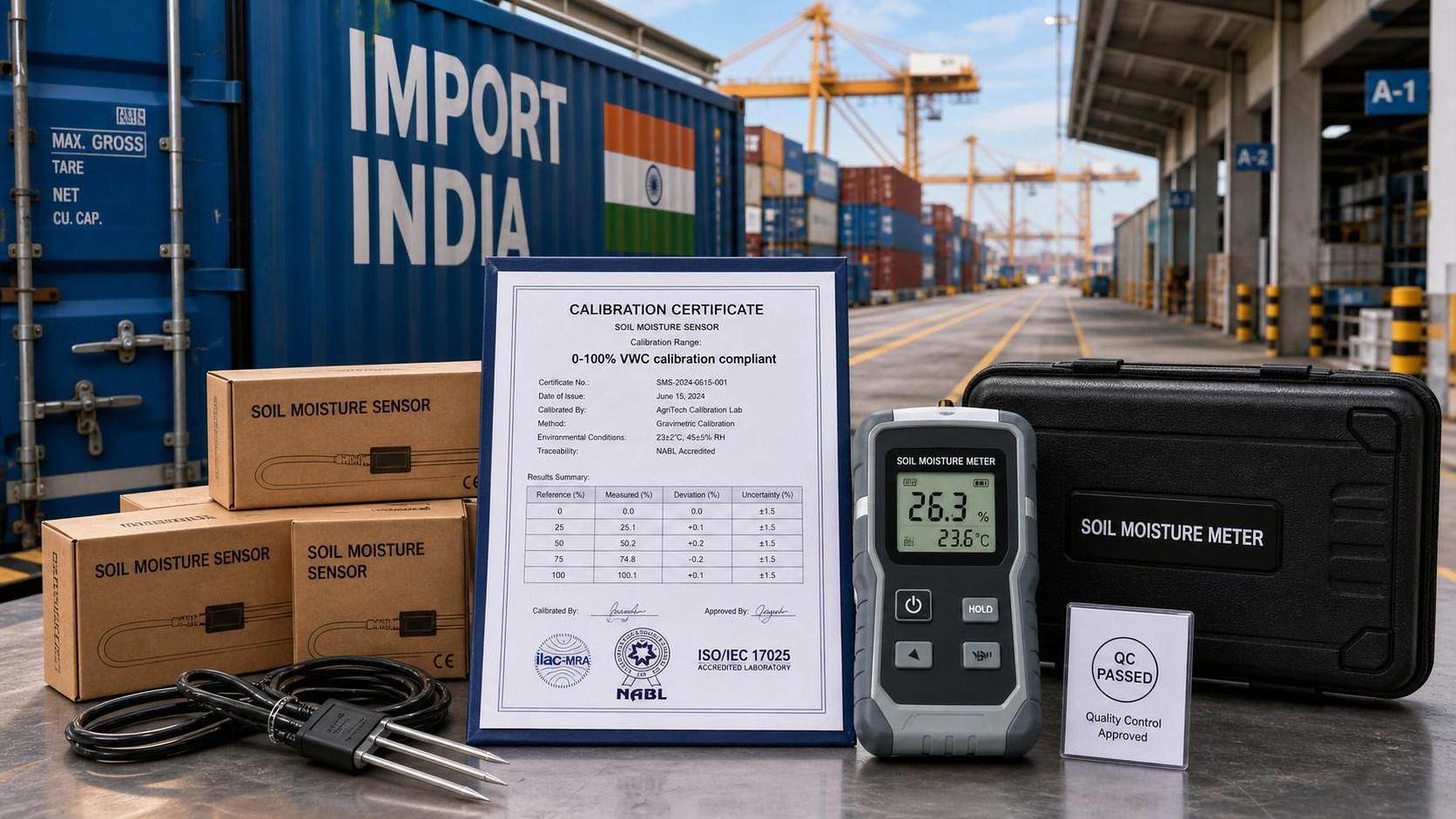




On July 1, 2026, India moved to tighten import checks on Soil Moisture Sensors through an updated CBIC inspection guideline for agricultural sensing equipment. The immediate issue for the market is document compliance at customs: imported shipments now need a calibration certificate from a NABL-accredited laboratory, covering point-by-point calibration across the full 0-100% VWC range and including an uncertainty statement. This is already affecting cargoes in transit through Mumbai and Chennai, making the change relevant not only to sensor importers but also to manufacturers, distributors, procurement teams, and supply chain operators tied to agricultural sensing products.
A documentation rule that now determines customs clearance
According to the information provided, the Central Board of Indirect Taxes and Customs (CBIC) updated its import inspection guidance for agricultural sensor equipment on July 1, 2026.
Under the updated requirement, all Soil Moisture Sensors presented for import clearance in India must be accompanied by a calibration certificate issued by a NABL-accredited laboratory.
The certificate must cover point-by-point calibration across the full measurement range of 0-100% volumetric water content (VWC), and it must include a statement of uncertainty.
The rule took effect immediately. If the required documentation is missing, shipments are to be treated as technically non-compliant and returned.
The update has already affected multiple in-transit containers at the ports of Mumbai and Chennai.
Where the pressure is likely to fall across the supply chain
Importers face a direct customs compliance risk
From an industry perspective, importers are the first group exposed to the rule because customs clearance now depends on a specific technical document rather than only on commercial or shipping paperwork. The practical impact is likely to appear at the declaration stage, document review stage, and arrival planning stage. What deserves closer attention is whether every shipment file already contains a certificate that matches the stated format and scope.
Manufacturers may need to align product release documents more closely
Analysis shows that manufacturers supplying the Indian market may come under pressure from customers to provide calibration records that meet the new customs threshold. The impact is likely to center on pre-shipment documentation, laboratory coordination, and delivery readiness. For suppliers, the key question is no longer only whether the sensor has been tested, but whether the available certificate is issued by a NABL-accredited laboratory and covers the full 0-100% VWC range with uncertainty declared.
Distributors and channel partners may see delivery timing disruptions
Observably, channel-side businesses may be affected where incoming inventory is tied to committed delivery schedules. If cargo is delayed or returned for technical non-compliance, the immediate pressure may shift to stock availability, customer communication, and order rescheduling. The point to monitor is whether existing pipeline inventory was prepared under the previous documentation expectation and is now exposed to clearance interruption.
Service providers in logistics and customs handling will need tighter document screening
For logistics coordinators, customs brokers, and related service providers, the likely impact is operational rather than commercial in the first instance. Shipment readiness checks may need to move earlier in the export-import process, with greater attention to technical attachments. The most relevant change is that missing or incomplete calibration evidence can now lead to return of goods, which raises the importance of document verification before cargo arrival.
What companies should watch immediately
Check whether current shipment files meet the exact certificate threshold
Companies handling Soil Moisture Sensors for the Indian market should first verify whether the calibration document on hand is issued by a NABL-accredited laboratory, whether it is point-by-point, whether it covers 0-100% VWC, and whether uncertainty is explicitly stated. The wording matters because the issue described in the update is technical compliance at import declaration.
Separate product qualification from customs-ready documentation
Analysis shows that a product being technically acceptable in commercial use is not the same as being supported by the exact documentation now required for customs. Businesses should therefore distinguish between internal test records, supplier quality documents, and the specific certificate needed for Indian import clearance.
Review in-transit and near-term deliveries first
Because the rule is already in force and has affected cargoes at Mumbai and Chennai, the near-term priority is not abstract policy tracking but shipment-level exposure. Importers, exporters, and distributors should identify which consignments are already moving, which are awaiting customs filing, and which can still be held for document completion before dispatch.
Follow whether enforcement language is clarified further
What deserves closer attention is the gap between the published requirement and its practical handling at ports over time. Businesses should keep monitoring whether official wording, inspection handling, or supporting interpretations become more detailed, especially around certificate form, matching of product models to documents, and treatment of shipments already in transit.
Why this reads as more than a routine paperwork update
Observably, this development signals that technical paperwork for agricultural sensing equipment is being treated as a frontline compliance issue at the border, not as a secondary afterthought. That matters because the requirement is specific, immediate, and linked to return of goods rather than a softer corrective path in the information provided.
It is more appropriate to understand this as an active compliance shift with immediate operational consequences, while still treating its broader market effect as something that requires continued observation. The confirmed facts show enforcement pressure now; they do not yet establish how far the requirement will reshape sourcing behavior, supplier selection, or product planning over a longer cycle.
How to interpret the development at this stage
At this point, the clearest industry meaning is that Soil Moisture Sensor imports into India have entered a stricter documentation phase tied directly to customs outcomes. The immediate concern is shipment compliance, not theoretical market change.
Analysis shows that companies should read this neither as a temporary shipping inconvenience nor as a basis for broad conclusions beyond the provided facts. A more balanced interpretation is that this is an enforceable short-term rule change with the potential to become a longer-term compliance signal, and it merits close tracking as implementation continues.
Basis of this article and points for ongoing verification
This article is based on the user-provided news title, event date, and event summary concerning India's tighter import inspection of Soil Moisture Sensors from July 1, 2026.
For developments of this kind, the source types typically relevant to verification include official government notices, customs guidance documents, company disclosures, industry association updates, authoritative media reporting, and standard-related technical documents.
No specific official source link was provided in the input. That means the exact wording of the updated guidance, any later clarification, and any port-level implementation details still require ongoing verification. The main follow-up points are whether CBIC issues further interpretive language and whether enforcement practice remains consistent across affected ports and future shipments.
Related News
Climate-Smart Farming for Drought: A Practical Plan for Protecting Yields
Climate-smart farming for drought: build smarter water budgets, protect critical crop stages, improve irrigation uniformity, and safeguard yields with practical field-proven strategies.

How Digital Agriculture Platforms Turn Field Data Into Better Input Decisions
Digital agriculture platforms turn field data into smarter fertilizer, water, seed, and equipment decisions—helping farms cut risk, improve margins, and scale sustainability.

GPS-Guided Farm Machinery: Where It Delivers Measurable Field Efficiency Gains
Agri-mechanization GPS guided systems deliver measurable field efficiency gains through reduced overlap, precise planting, smarter inputs, and reliable farm data.

How Sensor Feedback Enables Accurate Variable-Rate Fertilization in Field Conditions
Precision fertilization systems with sensor feedback improve variable-rate accuracy by verifying flow, managing latency, and ensuring reliable field application.

How to Select Precision Crop Protection Equipment for Variable Field Conditions
Precision crop protection equipment selection made simple: compare terrain, canopy, weather, control accuracy, and data workflows for reliable applications.

When Does Agricultural Machinery Leasing Cost Less Than Owning Equipment?
Agricultural machinery leasing can lower farm costs when use is seasonal or uncertain. Compare utilization, maintenance, cash flow, and risk to make a smarter equipment decision.

How to Evaluate Precision Fertilization System Suppliers for Farm-Scale Deployment
Precision fertilization systems suppliers: learn how to compare accuracy, integration, uptime, service, and total cost for confident farm-scale deployment.

ISOBUS for Smart Agriculture: How It Connects Tractors, Implements, and Farm Data
ISOBUS for smart agriculture connects tractors, implements, terminals, and farm data—helping growers improve precision, documentation, and smarter field decisions.
Automated Water-Saving Irrigation: How to Cut Water Use Without Reducing Crop Yields
Automated water-saving irrigation helps farms cut water use, protect crop yields, improve scheduling, and gain reliable control with sensors, flow monitoring, and smart zones.
Related News
- 00
0000-00
Climate-Smart Farming for Drought: A Practical Plan for Protecting Yields - 00
0000-00
Selecting Real-Time Soil Moisture Sensors for Irrigation Zone Control - 00
0000-00
How Does Climate-Smart Farming Reduce Water Use in Semi-Arid Areas? - 00
0000-00
USDA Rule Takes Effect: Dual FCC and NRCS Approval for Soil Moisture Sensors - 00
0000-00
EU Rule Takes Effect: Soil Moisture Sensors Need Revised CE-EMC Certification
Popular Tags
Hydrological Resource Strategist
Weekly Insights
Stay ahead with our curated technology reports delivered every Monday.