
Rail Corridor Shift Cuts Delivery Time for Center Pivot Systems
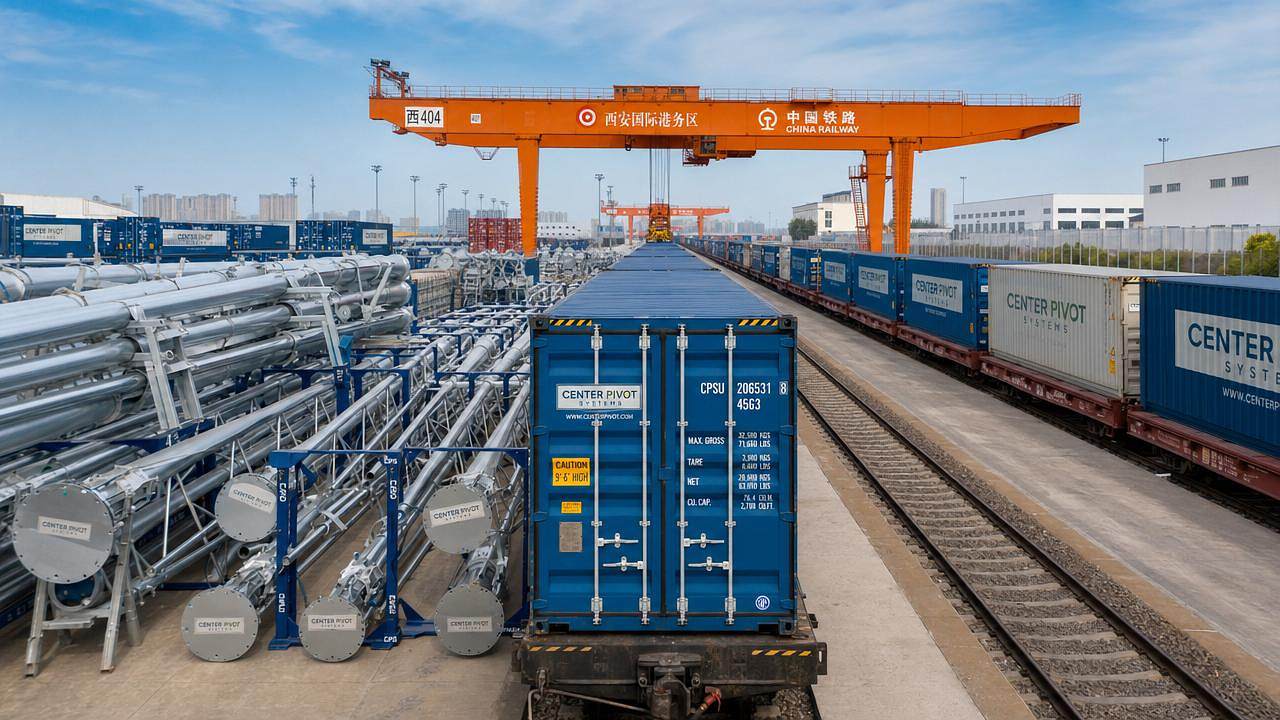




On June 8, 2026, the latest update on the China-Europe rail middle corridor pointed to more than a transport milestone: it showed that a route-level execution change, centered on priority loading and customs pre-inspection for complete Center Pivot Systems container shipments, is already affecting delivery planning, trade execution, and compliance coordination. For exporters, buyers, manufacturers, and supply chain service providers, the development deserves attention because it links operational rules on the corridor directly to lead times, documentation readiness, and lower-carbon delivery options.
What the corridor update confirms
According to the latest notice from China State Railway Group, the China-Europe rail middle corridor running from Xi'an through Horgos, Almaty, Tbilisi, and Istanbul handled 2,017 train services in January-May 2026, up 41% year on year.
The same update states that the corridor has implemented a priority loading and customs pre-inspection mechanism for complete Center Pivot Systems container shipments.
Under that mechanism, the average overland transit time for those shipments has been reduced from 40 days to 28 days. The update also states that this is 12 days faster than sea transport and cuts carbon footprint by 65%.
Where the operational change may matter first
For exporters managing delivery commitments
Analysis shows that exporters of Center Pivot Systems may be affected first because the confirmed time reduction changes how delivery promises, shipment windows, and contract execution can be arranged. What deserves closer attention is not only faster transit, but also whether internal export documentation and customs-facing files are prepared early enough to match a pre-inspection-based process.
From a compliance perspective, these companies should pay attention to document completeness, consistency across shipment files, and any corridor-specific handling requirements tied to priority loading. The update confirms that a mechanism exists, but it does not provide detailed operating criteria, so companies should avoid assuming uniform access conditions without further confirmation.
For manufacturers aligning production with dispatch timing
From an industry perspective, manufacturers may need to reassess the handoff between factory completion and container dispatch. A reduction from 40 to 28 days can affect production sequencing, final assembly release, packing readiness, and shipment booking coordination.
What deserves closer attention is whether technical documents, packing records, and shipment-supporting materials are ready earlier in the process. If a faster corridor is now available for complete units, any delay in factory-side paperwork could reduce the practical benefit of the shorter rail schedule.
For buyers and procurement teams balancing lead time and risk
Observably, procurement teams may view the corridor update as a signal that overland delivery is becoming more usable for time-sensitive orders of complete systems. The key impact is likely to appear in sourcing decisions, tender timing, delivery milestones, and inventory planning.
These buyers should pay attention to whether tender documents, purchase orders, and delivery clauses need to reflect different transit assumptions. They should also review whether supplier submissions clearly address shipping documents, customs-facing readiness, and traceability support for a rail-based route that depends on pre-inspection.
For logistics and trade service providers handling execution
Supply chain service providers may be affected through booking prioritization, customs coordination, and milestone visibility. Analysis shows that when a route introduces a priority loading and pre-inspection mechanism, execution quality may depend more heavily on document timing and inter-party coordination than on transport capacity alone.
For these service providers, the main point of attention is operational alignment: shipment file readiness, customs coordination sequence, and communication with cargo owners on cut-off expectations. The available facts confirm the mechanism and the time improvement, but do not define the detailed implementation standard, so service promises should remain carefully qualified.
What companies should monitor now
Check whether internal documentation can support pre-inspection
Analysis shows that the practical value of a customs pre-inspection mechanism depends on whether shipment files are accurate and ready before dispatch. Exporters and manufacturers should review the completeness of commercial, technical, and logistics documents used in cross-border execution, especially where complete-unit shipments are involved.
Update lead-time assumptions in procurement and delivery planning
The confirmed reduction to a 28-day average rail transit time may justify a review of internal planning benchmarks. What deserves closer attention is whether procurement schedules, customer delivery commitments, and spare capacity planning still rely on older 40-day assumptions for overland movement.
Watch for later clarification in operating practice
The summary confirms that priority loading and customs pre-inspection are in place, but it does not describe the detailed criteria, scope, or documentation thresholds for use. For that reason, companies should continue monitoring later official wording, execution practice, and any market-side clarification that affects access to the mechanism.
Link speed gains with traceability and after-sales readiness
A shorter delivery cycle can compress the timeline for installation support, acceptance preparation, and after-sales coordination. From an industry perspective, companies should check whether quality records, shipment traceability files, and service handover materials can move at the same pace as the faster corridor schedule.
How this signal should be read
Observably, this development is more appropriate to understand as an execution signal rather than a broad policy rewrite. The confirmed facts show that a corridor-level mechanism is already being applied to complete Center Pivot Systems container shipments and that measurable logistics effects have been reported.
At the same time, analysis shows that the market should be careful not to treat this as a fully standardized rule set across all cargo types or all users without further detail. The most important takeaway at this stage is that transport efficiency is increasingly linked to compliance readiness, documentation discipline, and the ability to match corridor procedures in practice.
Why the market should treat this as a practical change
The industry significance of this update lies in the connection between route operations and commercial execution. A shorter rail cycle, a stated pre-inspection process, and lower reported carbon footprint together create a concrete planning reference for trade, procurement, and supply chain decisions around complete Center Pivot Systems shipments.
Current observation suggests that the update should be read neither as a routine traffic statistic nor as a final settled rule environment. It is better understood as a confirmed operational change with real commercial implications, while detailed execution standards and market-wide application still require continued observation.
Basis of this article
This article is generated from the user-provided news title, event date, and event summary. It is written as an industry analysis item rather than a verbatim news brief.
For developments of this kind, commonly relevant source types may include official notices, railway or transport authority releases, customs or trade administration information, industry association updates, standard-setting documents, and reporting by authoritative media. A specific official source link was not provided in the input, so continued verification remains necessary.
What still needs ongoing observation includes any later clarification of operating rules, compliance interpretation, documentation expectations, tender wording changes, market feedback, and the actual execution experience of participating companies.
Related News

How Tractor Intelligence Systems Improve Field Efficiency and Input Accuracy
Agricultural machinery intelligence for tractors improves field efficiency, input accuracy, data traceability, and implement control. Explore smarter evaluation strategies.

How to Evaluate Crop Monitoring System Manufacturers for Large-Scale Farms
Compare crop monitoring systems manufacturers for large-scale farms. Evaluate data quality, integration, durability, lifecycle costs, support, and pilots for smarter decisions.

Wireless Agricultural Automation for Remote Irrigation and Field Monitoring
Agricultural automation wireless solutions improve remote irrigation with reliable field data, local control, flow verification, and smarter monitoring. Explore resilient deployment strategies.

Agricultural Product Information Market Guide: Key Data for Sourcing Decisions
Agricultural product information market guide for smarter sourcing—compare machinery, irrigation, precision tools, lifecycle costs, and supplier risk.

Large-Scale Farm Equipment Cost Comparison: Price, Fuel, and Lifecycle Value
Large-scale farm equipment cost comparison: evaluate price, fuel, maintenance, downtime, and lifecycle value to choose tractors, combines, irrigation, and smart tools with confidence.

A Procurement Specification Preparation Example for Buying Farm Equipment
Procurement specification preparation example for farm equipment: learn to define requirements, compare suppliers, control lifecycle costs, and buy with confidence.

What Tractor Horsepower Is Needed for a Three-Bottom Moldboard Plow?
What tractor horsepower is needed for three-bottom moldboard plow? Compare 60–100 hp needs by soil, depth, traction, and plow width for a confident equipment match.

How Does Climate-Smart Farming Reduce Water Use in Semi-Arid Areas?
How does climate-smart farming reduce water use in semi-arid zones? Discover precision irrigation, soil monitoring, and smarter crop planning for resilient yields.

Can Sustainable Farming Be Profitable Without Reducing Yields?
Are sustainable farming practices profitable without yield loss? Discover precision strategies that cut waste, protect yields, and improve farm margins.
Related News
- 00
0000-00
India Opens Duty Relief for Center Pivot Imports - 00
0000-00
What to Check Before Working With a Precision Irrigation Systems Factory - 00
0000-00
Red Sea Shock Tightens CPS Capacity, Rates Jump 37% - 00
0000-00
Red Sea Escalation Tightens Center Pivot Shipping - 00
0000-00
Red Sea Disruption Extends Center Pivot Transit to 42 Days
Popular Tags
Hydrological Resource Strategist
Weekly Insights
Stay ahead with our curated technology reports delivered every Monday.