
EU Tightens CE Rules for RTK GPS Guidance
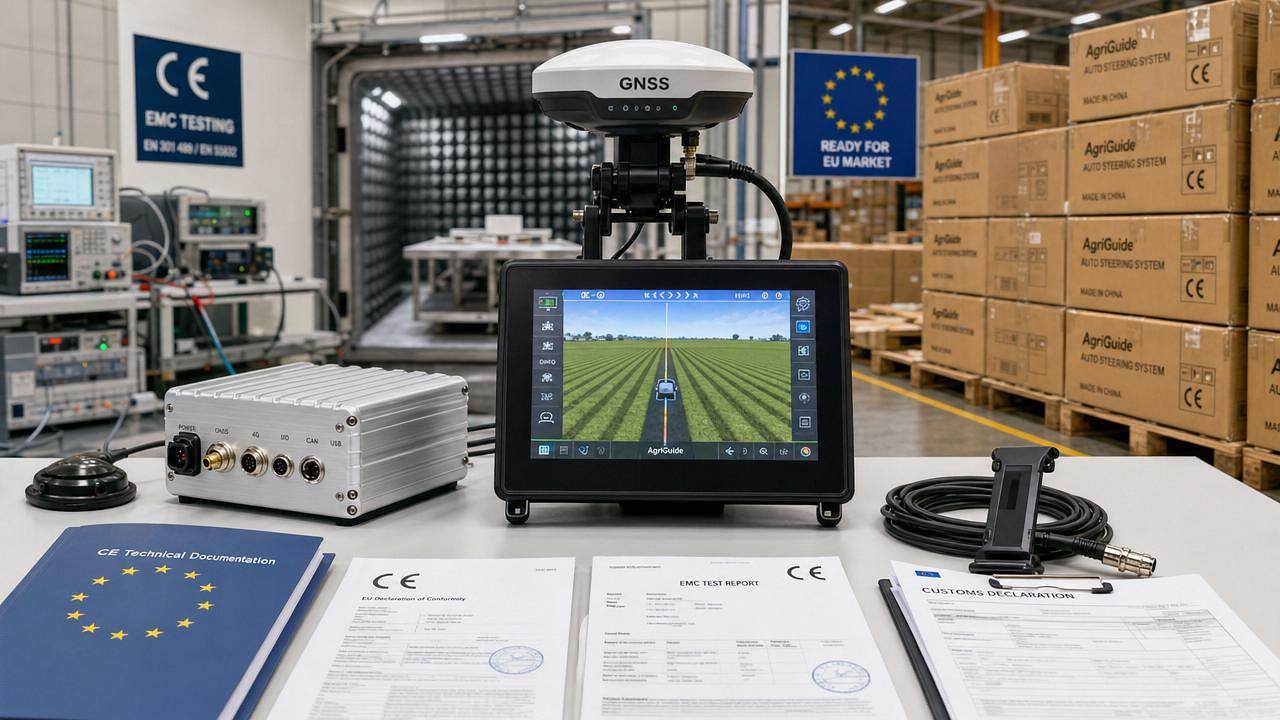




On June 11, 2026, the European Commission put into force Regulation (EU) 2026/947 for agricultural machinery safety, adding a new compliance threshold for GPS Guidance Systems equipped with RTK-GNSS functions. For companies shipping these products into the EU, the immediate issue is not only technical testing but also market access, because the rule takes effect at once, allows only a 60-day transition period, and ties certification directly to CE conformity declaration and customs clearance.
What the new requirement formally changes
According to the information provided, all GPS Guidance Systems with RTK-GNSS functions entering the EU market must pass newly added EMC tests for multipath interference resistance and signal drift under EN ISO 14223-3:2026.
The measure forms part of Regulation (EU) 2026/947 on agricultural machinery safety, which officially took effect on June 11, 2026.
The rule is implemented immediately, with a transition period of only 60 days.
The same information states that the requirement directly affects more than 73% of China’s intelligent navigation system export enterprises. Products without the required certification will be unable to complete the CE conformity declaration and will not clear customs.
Where pressure is likely to appear first
Export-facing equipment suppliers confront an immediate compliance gate
For manufacturers and exporters selling RTK-enabled GPS Guidance Systems into the EU, the impact is likely to be concentrated in certification readiness, shipment scheduling, and document completion. From an industry perspective, the key change is that compliance is no longer limited to general CE expectations but now includes the newly specified EMC testing for multipath interference and signal drift.
Production and delivery teams may need to reassess outgoing models
For manufacturing operations, the main concern is whether current products intended for the EU market can satisfy the added test requirement within the short transition window. Analysis shows that any model not aligned with the new testing expectation may face disruption at the stage of final compliance review, export release, or customer delivery planning.
Customs, documentation, and channel partners face execution risk
For distributors, importers, and supply chain service providers, the issue is practical execution. If a product cannot complete its CE conformity declaration, the problem moves quickly from technical compliance to customs clearance and contractual delivery. What deserves closer attention is the link between certification status and physical market entry, because this makes paperwork and timing as important as product performance.
What companies should review now
Check which product lines fall within scope
Companies should first identify which exported GPS Guidance Systems include RTK-GNSS functions and are therefore exposed to the new requirement. In practice, this is the threshold question for deciding whether shipments, quotations, and customer commitments to the EU need adjustment.
Verify the certification path against the new test item
What deserves closer attention is whether existing CE compliance workflows already cover the newly introduced EMC testing for multipath interference resistance and signal drift under EN ISO 14223-3:2026. The policy signal and the operational requirement are not the same: recognition of the rule does not by itself resolve test readiness or documentation sufficiency.
Review delivery schedules during the 60-day transition window
Because the transition period is limited to 60 days, companies should pay close attention to pending shipments, delivery milestones, and customer acceptance timing for EU-bound goods. Analysis shows that even short delays in certification preparation could create downstream pressure in customs handling and order fulfillment.
Prepare customer and partner communication materials
Suppliers, exporters, and channel partners may need to align on product status, certification progress, and document availability. From an industry perspective, this is especially relevant where buyers, importers, or logistics partners require confirmation that CE-related paperwork can still be completed without interruption.
Why this should be read as more than a narrow test update
Observably, this development is not just a technical revision to one testing item. It already creates a clear market access result because uncertified products cannot complete CE conformity declaration or clear customs. That makes the change more concrete than a preliminary policy signal.
At the same time, it is more appropriate to understand this as both an immediate compliance change and a longer-term regulatory signal. The immediate part is the new test requirement and short transition period. The longer-term signal is that technical performance related to RTK-GNSS reliability is being drawn more directly into EU market-entry control for agricultural machinery applications.
Further observation is still necessary on how companies adjust their certification arrangements and shipment planning within the transition period, but the existence of the compliance requirement itself is already clear from the provided information.
How the sector may best interpret this stage
Based on the confirmed information, the most important takeaway is that this is not a distant regulatory direction but an active entry condition for affected products. For exporters, manufacturers, importers, and service providers connected to RTK-enabled guidance systems, the main issue is execution speed under a compressed timeline rather than abstract policy interpretation.
From an industry perspective, the current stage is best understood as an immediate compliance adjustment with broader regulatory implications. It does not by itself prove how the wider market will reorganize, but it does show that certification readiness, technical validation, and document control now sit closer to the center of EU market access for this product category.
Basis of this article and points to keep tracking
This article is generated based on the user-provided news title, event date, and event summary. The confirmed factual basis includes the stated effective date of June 11, 2026, Regulation (EU) 2026/947, the added EMC testing requirement under EN ISO 14223-3:2026 for RTK-GNSS-enabled GPS Guidance Systems entering the EU market, the 60-day transition period, and the stated impact on more than 73% of China’s intelligent navigation system export enterprises.
For this type of industry update, source categories typically relevant for continued verification include official regulatory notices, company compliance disclosures, industry association updates, authoritative media reporting, and standards organization documents. A specific official source link was not provided in the input, so the exact source document path still requires ongoing verification. Areas that remain worth tracking include any further official wording updates, implementation clarifications, and how certification timing affects shipment and customs execution in practice.
Related News

How RTK Satellite Positioning Improves Accuracy in Precision Farming Operations
RTK satellite positioning boosts precision farming with repeatable guidance, lower overlap, and better field data. Learn what to verify before choosing an RTK system.
EU Rule Takes Effect: EN 16924:2026 for Drip Irrigation Logic
EN 16924:2026 now reshapes EU access for Drip Irrigation Logic products. Learn how certification, CE marking, customs, and warehouse risks impact exporters and buyers.

How Autonomous Machinery for Crop Scouting Helps Growers Detect Field Issues Earlier
Autonomous machinery for crop scouting helps growers spot irrigation gaps, pest pressure, and crop stress earlier, turning field data into faster decisions and smarter action.
USDA Rule Makes ISO 21648:2026 Mandatory
USDA Rule Makes ISO 21648:2026 Mandatory for soil moisture sensors entering the U.S. Learn how the new USDA import compliance guide impacts certification, CBP entry, suppliers, and delivery plans.

How Digital Farming Improves Irrigation Planning With Soil Data and GPS Mapping
Digital farming for irrigation planning turns soil data and GPS mapping into smarter watering decisions, helping farms reduce waste, improve field precision, and boost operational efficiency.
EU Rule Takes Effect: EN 16842-2026 Required for Drip Irrigation Logic Exports
EN 16842-2026 now makes third-party certification mandatory for Drip Irrigation Logic exports to the EU. Learn the compliance risks, customs impact, and supplier checks now.

How to Evaluate Autonomous Machinery for Vineyards by Terrain, Tasks, and ROI
Autonomous machinery for vineyards: learn how to evaluate terrain fit, task suitability, safety, and ROI to choose the right solution and reduce procurement risk.

USDA Tightens Import Rules for Soil Moisture Sensors
Soil Moisture Sensors face new USDA import rules from Oct. 1, 2026. Learn how ISO 11274-3:2026 testing may impact customs clearance, lead times, and supplier planning.

How to Use a Global Agricultural Equipment Directory to Compare Suppliers and Reduce Sourcing Risk
Agricultural equipment directory global sourcing starts with smarter supplier comparison. Learn how to assess fit, compliance, support, and market readiness to reduce sourcing risk.
Related News
- 00
0000-00
How RTK Satellite Positioning Improves Accuracy in Precision Farming Operations - 00
0000-00
How Digital Farming Improves Irrigation Planning With Soil Data and GPS Mapping - 00
0000-00
EU CE Guide Adds RTK Interference Tests for GPS Systems - 00
0000-00
US Import Rule Tightens for GPS Guidance Systems - 00
0000-00
USDA Sets Dual Certification Rule for GPS Guidance Systems
Popular Tags
Tractor Power Architect
Weekly Insights
Stay ahead with our curated technology reports delivered every Monday.