
Long-Cycle Agri-Trade Price Trends: How to Read Supply, Freight, and Currency Signals
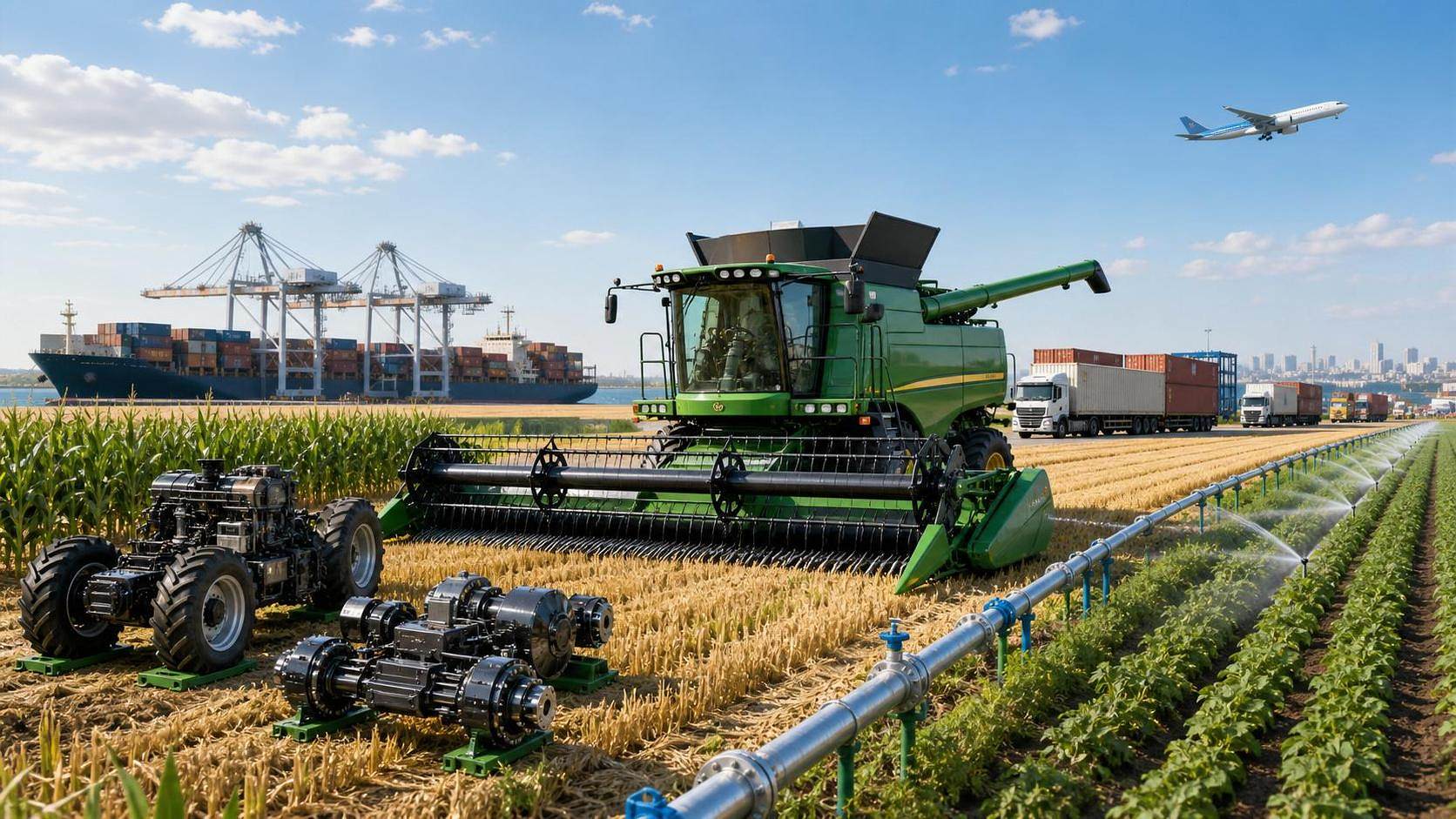




Long-cycle agri-trade price trends are no longer moving in isolation
Long-cycle agri-trade price trends now reflect a tighter link between crop economics, industrial inputs, transport costs, and capital flows.
That matters across the wider agricultural equipment chain, from tractor chassis and combines to irrigation systems and sensor-driven farm tools.
What once looked like separate market swings is increasingly one connected pricing story.
A steel cost change can alter equipment quotes months later.
A freight disruption can distort availability before field demand visibly shifts.
A currency move can improve export competitiveness while squeezing imported hydraulic, electronic, or irrigation components.
For long-cycle agri-trade price trends, the useful signal rarely sits in one dataset alone.
The better reading comes from watching supply, freight, and currency together, then testing how those signals pass through different equipment categories.
That approach aligns with how AP-Strategy reads Agriculture 4.0 markets: not only through product demand, but through the operating conditions behind it.
The current shift is less about spikes and more about persistence
Recent long-cycle agri-trade price trends show fewer short-lived shocks and more layered persistence.
Input costs may cool in one quarter, yet delivered equipment prices stay firm because logistics, financing, and exchange rates lag behind.
This is especially visible in large-scale agri-machinery.
High-value machines carry long lead times, heavier shipping exposure, and wider supplier networks.
As a result, price resets happen slowly.
Combine harvesters and intelligent irrigation systems show a similar pattern, though for different reasons.
Harvesters depend on seasonal delivery windows and precision parts.
Irrigation networks depend on plastics, pumps, electronics, and project scheduling.
Both categories absorb volatility over time rather than instantly.
This persistence is why long-cycle agri-trade price trends can mislead anyone looking only at spot commodity charts.
Three signals now explain more than headline prices
Looked at together, these signals explain why long-cycle agri-trade price trends often feel disconnected from simple demand narratives.
Why supply has become a slower but deeper pricing force
Supply pressure is no longer just a factory output issue.
It now includes upstream metals, specialized castings, semiconductors, powertrain parts, irrigation components, and software-linked control systems.
In the AP-Strategy view, this is where Agriculture 4.0 changes the reading of long-cycle agri-trade price trends.
The more intelligence added to equipment, the more price formation depends on mixed supply chains.
A tractor chassis is still shaped by steel, machining, and hydraulics.
Yet precision guidance, sensor arrays, telematics, and variable-rate applications add another layer of sourcing risk.
That means supply-driven long-cycle agri-trade price trends are becoming more structural.
Even when raw material inflation cools, embedded technology costs may stay elevated.
This also changes substitution logic.
A buyer can switch steel suppliers more easily than navigation chips or smart irrigation controllers.
The result is narrower flexibility and stickier prices.
Freight volatility is influencing strategy more than many balance sheets show
Freight has become a strategic variable, not just a logistics line.
Heavy machinery, modular harvest systems, and irrigation assemblies all respond differently to transport disruption.
Bulky equipment can tolerate some price inflation, but not repeated schedule uncertainty.
Project-based irrigation systems often face the reverse problem.
Freight delays can damage installation timing more than transport cost itself.
This is why long-cycle agri-trade price trends should be read with route exposure in mind.
Two identical product quotes can imply very different landed outcomes.
More noticeable lately is the gap between ocean normalization and inland instability.
Port congestion may ease while regional trucking, warehousing, or customs clearance remains costly.
That hidden gap is where many pricing assumptions fail.
- Large machines feel freight risk through shipping density, route restrictions, and dealer delivery windows.
- Combine systems feel it through harvest timing and the cost of missing narrow field operating periods.
- Smart irrigation projects feel it through phased installation, spare-part availability, and site readiness.
Currency moves are reshaping the meaning of a stable price tag
Currency is often the least visible part of long-cycle agri-trade price trends, yet it may be the most distorting.
An equipment quote may look unchanged in dollars or euros.
The real economics can still shift sharply once local settlement, imported components, and financing costs are layered in.
This is especially relevant for global agri-equipment flows.
Engines, hydraulic controls, sensors, pumps, nozzles, and digital modules often cross borders several times before final assembly.
So currency affects more than export competitiveness.
It changes replacement cost, service margins, warranty exposure, and inventory valuation.
For long-cycle agri-trade price trends, currency also influences timing behavior.
When exchange rates swing quickly, market participants delay commitments, shorten quote validity, or push for flexible terms.
That behavior can soften order visibility even when end demand remains intact.
The impact is spreading across equipment categories in uneven ways
One mistake in reading long-cycle agri-trade price trends is assuming all agricultural segments react at the same speed.
They do not.
Large-scale agri-machinery typically absorbs cost shifts through longer quote cycles and financing structures.
Combine harvesters are more exposed to seasonal timing and performance expectations.
Tractor chassis sit at the intersection of powertrain cost, regulation, and durability requirements.
Intelligent farm tools respond faster because electronics turnover is quicker.
Water-saving irrigation systems are often tied to regional climate pressure and public or private investment cycles.
This uneven pass-through matters for business evaluation.
It changes which price moves are temporary and which ones signal a structural reset.
More importantly, it shows why benchmarking one segment against another can produce weak conclusions.
What deserves closer attention now
- Whether component cost declines are actually reaching final quotes, or stopping at intermediate tiers.
- Whether freight normalization applies to the full route, not just ocean legs.
- Whether currency pressure is changing service, spare parts, or financing more than equipment list prices.
- Whether autonomous and precision systems are adding resilience value that offsets higher upfront pricing.
A sharper reading starts with signal combinations, not single indicators
The most useful interpretation of long-cycle agri-trade price trends is comparative rather than absolute.
Instead of asking whether prices are up or down, the better question is which signal is driving the move and how long it can last.
In practical terms, supply tightening with stable freight suggests a different risk profile than freight inflation with stable component costs.
Currency depreciation without demand collapse suggests another pattern entirely.
This is where intelligence platforms such as AP-Strategy create value.
The point is not to predict every swing.
It is to separate noise from structural change across machinery, harvest systems, chassis technology, precision tools, and irrigation networks.
That makes pricing judgments more defensible and timing decisions less reactive.
The next step is to build a repeatable watchlist
Long-cycle agri-trade price trends will remain sensitive to food security policy, climate pressure, technology adoption, and fragmented trade routes.
That argues for a disciplined watchlist rather than one-off market snapshots.
Useful monitoring starts with three linked checks: supply availability by component tier, freight exposure by route, and currency pass-through by contract structure.
Then compare those signals against category-specific demand in combines, tractor systems, intelligent tools, and irrigation projects.
The aim is not volume for its own sake.
It is to identify when a price move reflects temporary dislocation and when it signals a deeper market repricing.
That is the more reliable way to read long-cycle agri-trade price trends in a market where machinery performance, precision agriculture, and sustainability investment are increasingly tied together.
A grounded next move is to map these three signals quarterly, test them against actual delivered costs, and adjust evaluation assumptions before the next ordering cycle begins.
- intelligent irrigation systems
- Agriculture 4.0
- food security
- tractor chassis
- intelligent farm tools
- water-saving irrigation
- long-cycle agri-trade
- combine harvesters
- water-saving irrigation systems
- agricultural equipment
- long-cycle agri-trade price trends
- large-scale agri-machinery
- irrigation systems
Related News
Choosing a Digital Farming Platform Provider: Compatibility and Data Ownership
Compare digital farming platforms providers on equipment compatibility, data ownership, and export rights. Discover practical checks to avoid lock-in and choose with confidence.
How Large-Scale Farm Telematics Cuts Downtime Across Mixed Fleets
Large-scale farm equipment telematics cuts mixed-fleet downtime with real-time alerts, smarter maintenance, and stronger operational control. Learn how to protect critical farm workflows.
How to Size Low-Pressure Water-Saving Irrigation Systems for Uneven Fields
Low pressure water-saving irrigation systems for uneven fields: learn zoning, pressure mapping, pipe sizing, and pump selection to improve uniformity and reduce water waste.
Farm Machinery Sourcing: How to Vet Suppliers, Specs, and Lifecycle Costs
Farm machinery information for sourcing: learn to vet suppliers, compare specifications, control lifecycle costs, and secure reliable uptime for smarter equipment purchases.
What to compare in integrated seeding combinations for heavy soils
Compare integrated seeding combinations for heavy soils: depth control, residue flow, consolidation, traction, and field capacity for more uniform crop establishment.
When an integrated seeding combination improves field efficiency
Integrated seeding combination improves field efficiency, protects planting windows, and balances speed with seedbed quality, tractor capacity, and reliable establishment.
Which costs matter most when calculating precision agriculture ROI?
Calculating ROI on precision agriculture equipment? Discover the costs that shape returns, from installation and subscriptions to downtime, labor, and data integration.
How to calculate ROI on precision agriculture equipment before buying
Calculating ROI on precision agriculture equipment: learn to assess total ownership costs, savings, payback, NPV, risks, and farm-scale value before you buy.
Planning Nipple Drinker Installation for Different Chicken House Layouts
How to install nipple drinker for chicken houses: plan line layouts, pressure control, flushing access, and maintenance for reliable water delivery.
Related News
- 00
0000-00
How Does Farm Mechanization Affect Food Security in Developing Regions? - 00
0000-00
Agricultural Technology Insights by Region: Where Adoption Is Growing Fastest - 00
0000-00
How Climate-Smart Agriculture Technology Improves Yield, Soil Health, and Risk Resilience - 00
0000-00
Smart Farming Solutions in Latin America: Which Technologies Fit Large Farms Best? - 00
0000-00
Long-Cycle Agri-Trade Price Trends: How to Read Supply, Freight, and Currency Signals
Popular Tags
Prof. Marcus Chen
Weekly Insights
Stay ahead with our curated technology reports delivered every Monday.