
Hamburg Checks on Irrigation Controllers Jump to 32%
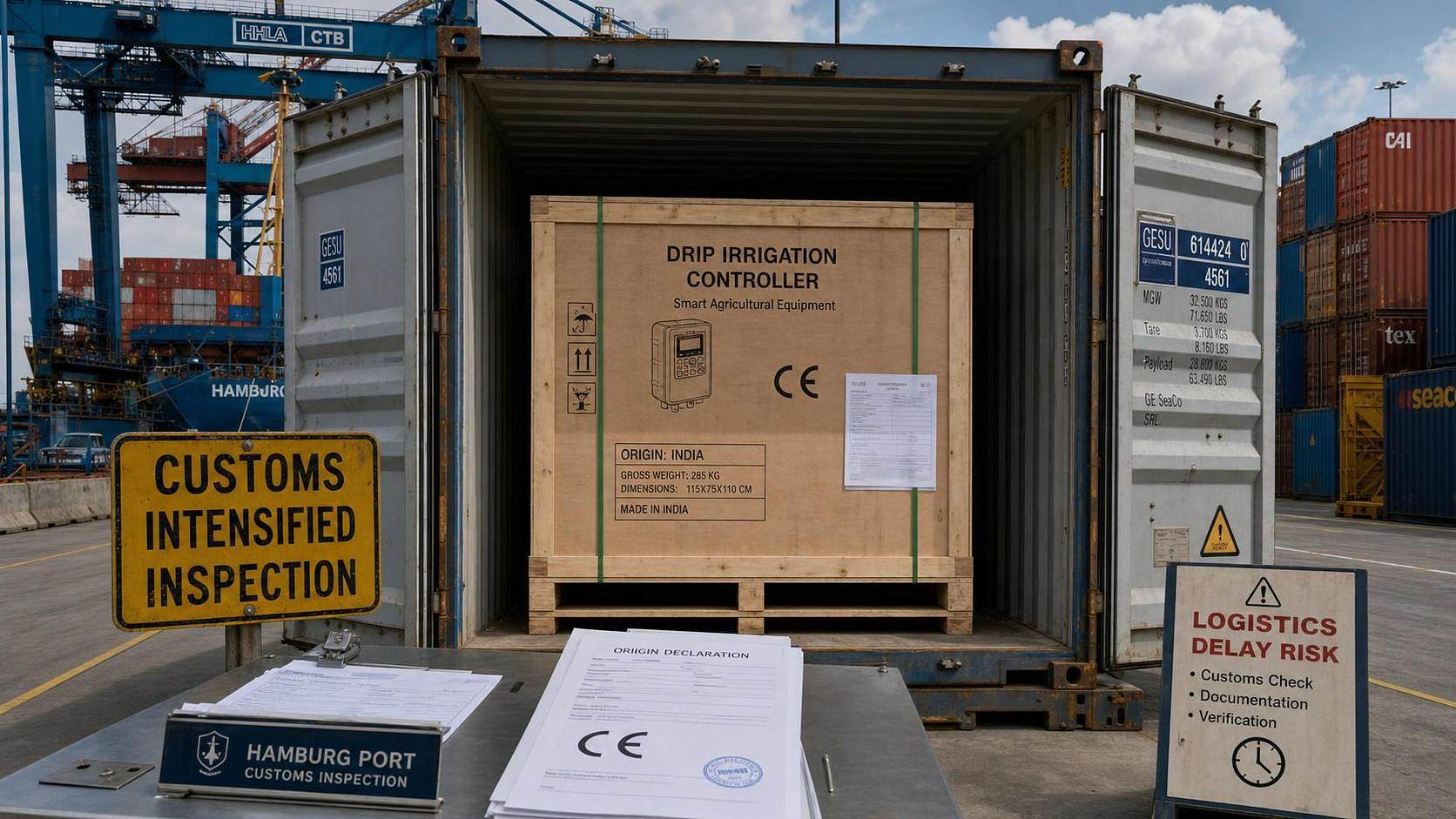




On July 12, 2026, Germany’s nine-day nationwide port strike came to an end, but the operational pressure on agricultural smart equipment shipments did not ease in parallel. Hamburg customs has moved to intensified inspections for this cargo category, raising the inspection rate for Drip Irrigation Logic containers from the usual 5% to 32%, with attention centered on the authenticity of the CE mark, EN 14904:2025 safety certification for irrigation controllers, and consistency in origin declarations. For exporters, importers, compliance teams, and logistics providers, this is worth close attention because it shifts the current bottleneck from labor disruption to document, certification, and customs review risk, while average delivery times for Chinese exports are already extending by 5 to 7 working days.
What has changed at Hamburg port
Confirmed information indicates that the Seeberufsgewerkschaft ended Germany’s nationwide port strike on July 12, 2026, after nine days. On the same date, Hamburg customs announced enhanced inspections for agricultural smart equipment cargo. Within that enforcement move, the inspection rate for Drip Irrigation Logic containers increased from a normal 5% to 32%.
The inspection focus has been specified in three areas: verification of the authenticity of the CE mark, review of EN 14904:2025 irrigation controller safety certification, and consistency checks on origin declarations. The information provided also states that average delivery times for Chinese exports have been extended by 5 to 7 working days.
Where the pressure is likely to appear first
Export shipments face a documentation-driven delay risk
From an industry perspective, exporters of agricultural smart equipment are the most immediate group affected because the tighter inspection ratio changes the practical clearance environment even after the strike has ended. The impact is likely to be concentrated in customs preparation, pre-shipment document review, and delivery scheduling. What deserves closer attention is whether CE marking files, certification records tied to EN 14904:2025, and origin statements are internally consistent before cargo reaches Hamburg.
Procurement and delivery planning may need adjustment
Buyers and procurement teams may feel the effect through longer lead times rather than through a direct policy obligation of their own. Analysis shows that a 5 to 7 working day extension in average export delivery time can affect inbound scheduling, installation timing, and project coordination for equipment tied to irrigation control systems. For these participants, the practical issue is not only transit delay but also whether suppliers can provide complete and review-ready compliance documents.
Logistics and customs service providers will need closer file screening
Supply chain service providers, including freight and customs handling teams, are likely to see more pressure in pre-clearance coordination. The immediate business impact is likely to fall on document matching, cargo classification support, and communication around inspection timing. Observably, service providers will need to pay closer attention to whether shipment files clearly support CE authenticity, EN 14904:2025 certification status, and declared origin consistency, because these are the areas specifically identified in the current checks.
Certification and testing-related service work may come under closer scrutiny
Certification-related businesses and testing support organizations may not be the direct target of the customs action, but they are adjacent to the compliance points now being examined. Their relevance lies in how quickly and clearly they can support exporters or buyers that need to validate certification records or technical documentation connected to irrigation controllers. The current signal is less about a new public rule text in the input and more about stricter execution around already shipment-critical compliance materials.
What companies should watch in the near term
Recheck CE mark evidence before shipment release
Analysis shows that companies shipping affected goods should pay immediate attention to whether the CE mark used on products, packaging, and shipment files can be supported by consistent underlying documentation. The input does not provide execution details beyond the inspection focus, so it would be premature to assume a uniform review method, but the compliance file itself is now a practical risk point.
Verify how EN 14904:2025 materials are presented in trade files
What deserves closer attention is not only whether certification exists, but whether the relevant records are presented consistently across customs, commercial, and technical documents. Because the provided information names EN 14904:2025 specifically, exporters, importers, and purchasing teams should closely monitor how this certification appears in shipment paperwork and technical support files tied to irrigation controllers.
Check origin declarations for consistency across the full document set
Origin declaration consistency has been identified as a review priority. In practical terms, companies should pay attention to whether origin statements align across core trade documents and any supporting compliance materials submitted for the shipment. The available information does not define a new documentary standard, so this should be treated as an area for heightened caution rather than as a fully clarified new rule framework.
Adjust delivery commitments with inspection risk in mind
Observably, the reported 5 to 7 working day extension for Chinese exports matters for order promises, installation dates, and after-sales coordination. Companies involved in affected cargo should therefore review current delivery commitments and procurement timing assumptions. This is not evidence of a permanent lead-time reset, but it is a current execution condition that can influence fulfillment reliability.
Why this looks more like an enforcement signal than a simple logistics story
Analysis shows that the end of the strike does not mark a return to normal handling conditions for all cargo categories. The more important development in this case is the shift from disruption caused by labor stoppage to disruption caused by intensified customs scrutiny on a defined equipment segment. It is more appropriate to understand this as an enforcement signal with immediate operational consequences, particularly for shipments that depend on clean certification and declaration files.
At the same time, this should not yet be overstated as a fully settled long-term rule change based only on the provided information. Observably, the current facts confirm stricter inspection activity and a stated focus in Hamburg, but the broader execution pattern, duration, and any further clarification in official language still require continued observation.
How the market should read the current development
The industry significance of this development lies in the fact that port normalization and customs normalization are no longer the same thing. Even after the strike has ended, inspection intensity on agricultural smart equipment can still slow cargo movement when certification, CE marking support, or origin documentation becomes the central checkpoint. From an industry perspective, the most balanced reading is that this is an already active operational change with direct compliance and delivery implications, while its longer-term enforcement rhythm still needs to be monitored rather than assumed.
Basis of this article and what still needs verification
This article is based on the user-provided news title, event date, and event summary. For developments of this type, commonly relevant source categories may include official notices, releases from regulatory authorities, customs or trade administration information, industry association updates, standards organization documents, and reporting by authoritative media.
No specific official source link was provided in the input, so the exact official documentation still requires ongoing verification. What should continue to be monitored includes any further policy detail, clarification of certification enforcement practice, changes in tender or technical document requirements, market feedback, and how affected companies implement compliance and delivery adjustments in response to the current inspection pattern.
Related News

Choosing a Digital Farming Platform Provider: Compatibility and Data Ownership
Compare digital farming platforms providers on equipment compatibility, data ownership, and export rights. Discover practical checks to avoid lock-in and choose with confidence.

How Large-Scale Farm Telematics Cuts Downtime Across Mixed Fleets
Large-scale farm equipment telematics cuts mixed-fleet downtime with real-time alerts, smarter maintenance, and stronger operational control. Learn how to protect critical farm workflows.
How to Size Low-Pressure Water-Saving Irrigation Systems for Uneven Fields
Low pressure water-saving irrigation systems for uneven fields: learn zoning, pressure mapping, pipe sizing, and pump selection to improve uniformity and reduce water waste.

Farm Machinery Sourcing: How to Vet Suppliers, Specs, and Lifecycle Costs
Farm machinery information for sourcing: learn to vet suppliers, compare specifications, control lifecycle costs, and secure reliable uptime for smarter equipment purchases.

What to compare in integrated seeding combinations for heavy soils
Compare integrated seeding combinations for heavy soils: depth control, residue flow, consolidation, traction, and field capacity for more uniform crop establishment.

When an integrated seeding combination improves field efficiency
Integrated seeding combination improves field efficiency, protects planting windows, and balances speed with seedbed quality, tractor capacity, and reliable establishment.

Which costs matter most when calculating precision agriculture ROI?
Calculating ROI on precision agriculture equipment? Discover the costs that shape returns, from installation and subscriptions to downtime, labor, and data integration.

How to calculate ROI on precision agriculture equipment before buying
Calculating ROI on precision agriculture equipment: learn to assess total ownership costs, savings, payback, NPV, risks, and farm-scale value before you buy.

Planning Nipple Drinker Installation for Different Chicken House Layouts
How to install nipple drinker for chicken houses: plan line layouts, pressure control, flushing access, and maintenance for reliable water delivery.
Related News
- 00
0000-00
How to Size Low-Pressure Water-Saving Irrigation Systems for Uneven Fields - 00
0000-00
Drip vs. Micro-Sprinkler Irrigation: Which System Fits Your Orchard? - 00
0000-00
How to Select Smart Irrigation Valves for Multi-Zone Water Management? - 00
0000-00
Automated Water-Saving Irrigation: How to Cut Water Use Without Reducing Crop Yields - 00
0000-00
How to Evaluate Drip Irrigation System Manufacturers for Large Farm Projects
Popular Tags
Hydrological Resource Strategist
Weekly Insights
Stay ahead with our curated technology reports delivered every Monday.