



The Short Answer: Savings Are Real, but the Duty Cycle Decides
Hybrid propulsion systems can reduce fuel use in farm machinery, but the result depends heavily on operating cycles, implement loads, terrain, and seasonal utilization.
For enterprise buyers, hybrid power should not be evaluated as a universal fuel-saving upgrade. It is a targeted efficiency strategy for specific machines and tasks.
The strongest business case usually appears where machinery experiences repeated acceleration, variable engine loading, hydraulic peaks, transport work, or extended idling during field operations.
In these conditions, batteries and electric motors can recover energy, support transient loads, and allow combustion engines to remain closer to efficient operating ranges.
Large tractors, self-propelled sprayers, forage harvesters, telehandlers, and combines can all benefit, although the economic logic differs substantially across each equipment category.
Fuel reduction is typically more credible in mixed-duty operations than in constant, high-load draft work where engines already operate near their optimum efficiency point.
Decision-makers should therefore start with a practical question: where does the fleet waste energy today, and can electrification reduce that specific waste?
The answer may involve partial hybridization, electric auxiliaries, regenerative systems, or power-split drivetrains rather than a fully electric agricultural platform.
Where Hybrid Farm Machinery Delivers the Best Fuel Reduction
Hybrid propulsion systems for agricultural machinery perform best when conventional diesel engines repeatedly operate away from their most efficient load and speed range.
Transport between fields is one important opportunity. Tractors hauling trailers must accelerate frequently, encounter road gradients, and often brake under substantial moving mass.
A hybrid system can provide electric torque during acceleration and capture a portion of braking energy, reducing diesel demand during recurring transport cycles.
Headland turns represent another opportunity. Many machines reduce productive output during turns while engines, hydraulics, and auxiliary systems continue consuming significant energy.
Electric assistance can smooth power delivery when implements are lifted, lowered, repositioned, or re-engaged, particularly in precision operations with frequent directional changes.
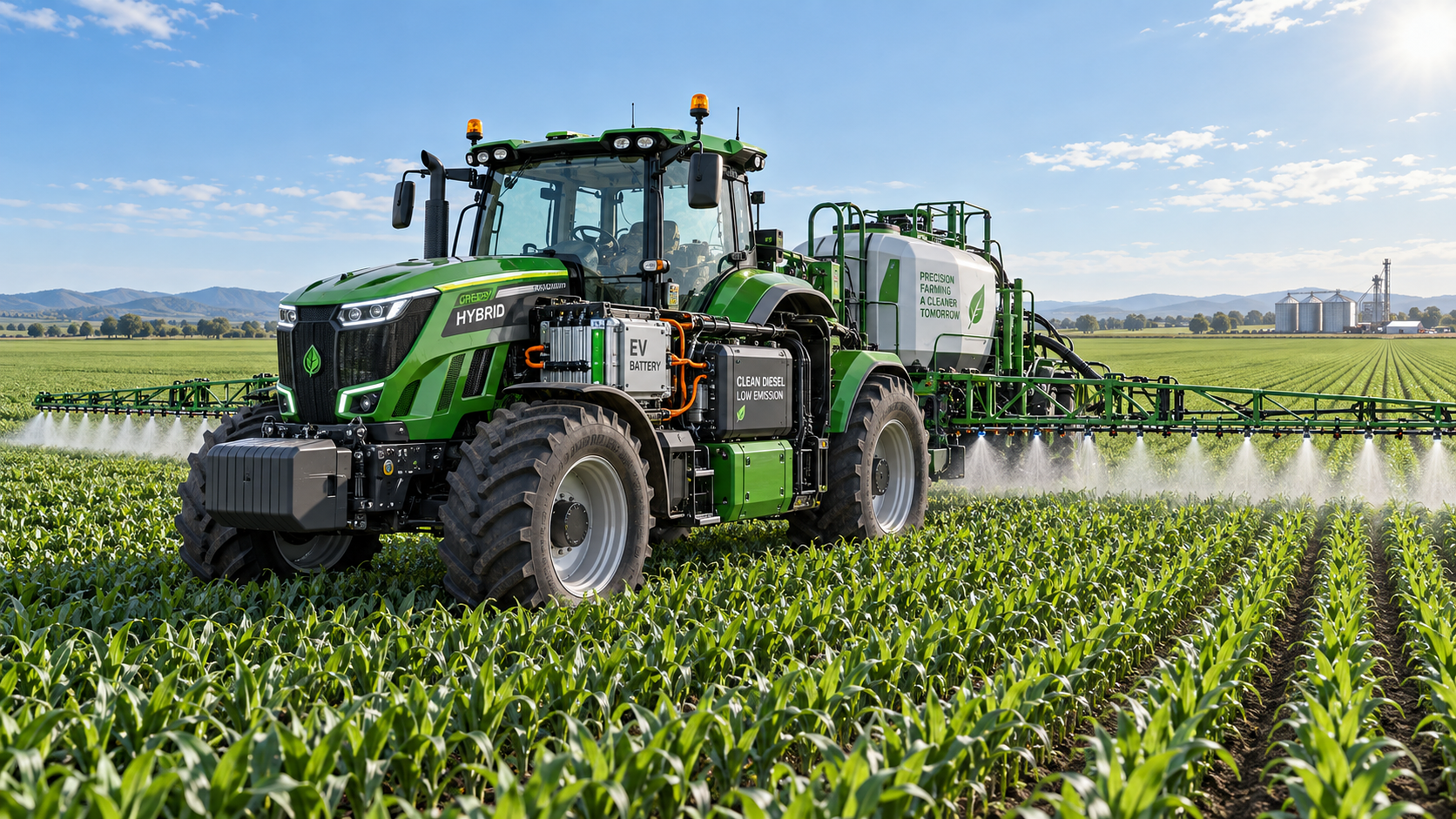
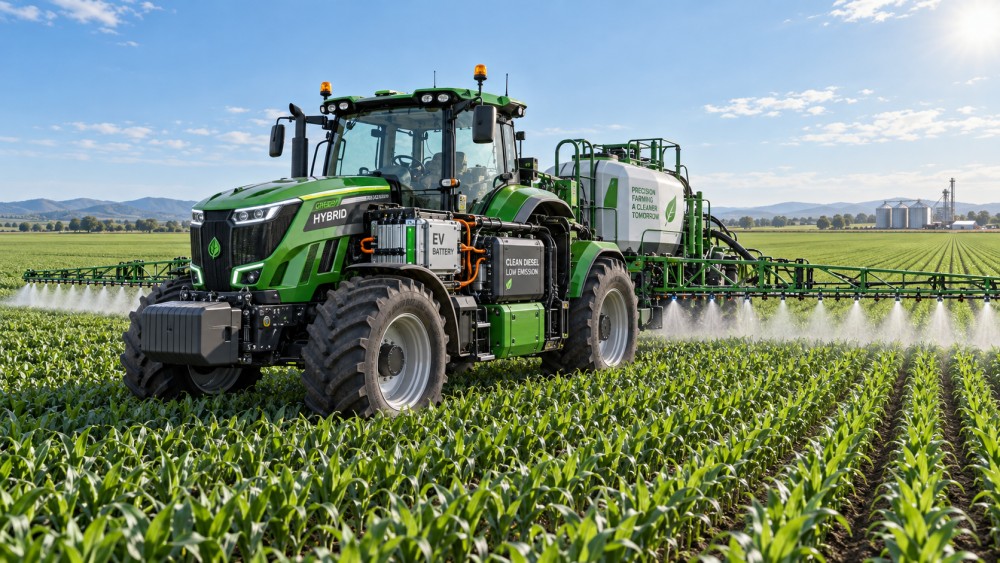
Self-propelled sprayers are promising candidates because their duty cycles combine driving, pumping, boom control, steering, and precision application functions with fluctuating demand.
Electric auxiliary drives can independently control fans, pumps, and compressors, avoiding the continuous mechanical losses associated with conventional belt or hydraulic arrangements.
Combine harvesters also offer significant potential because threshing, cleaning, unloading, propulsion, and residue management generate variable power needs across changing crop conditions.
Hybrid architectures can distribute power more intelligently between traction and processing systems, especially when sensor data identifies changing crop density, moisture, or slope.
However, a combine operating at full capacity through consistently heavy crop may have limited scope for fuel savings from traction hybridization alone.
The more compelling case may be electrically driven cleaning, separation, cooling, and unloading systems that adjust output precisely to real-time harvesting requirements.
How Much Fuel Can Operators Realistically Save?
Fuel-saving claims should be treated carefully because performance varies by machine class, hybrid architecture, application, operator behavior, and baseline diesel efficiency.
For many suitable use cases, a realistic planning range is often a single-digit to low-double-digit percentage reduction in fuel consumption rather than a dramatic transformation.
Higher savings may be possible where a machine spends substantial time idling, operating auxiliary equipment, performing repetitive handling work, or braking during transport.
Lower savings should be expected for deep tillage, heavy cultivation, and other applications requiring sustained maximum drawbar power over long continuous periods.
Management teams should avoid relying on a single liters-per-hour figure. Fuel use per hectare, per tonne harvested, or per productive operating hour is more useful.
A machine consuming fewer liters per hour can still create poorer economics if reduced power, extra weight, or charging constraints lower its daily productive capacity.
Fuel reduction must therefore be measured alongside field capacity, work quality, labor use, maintenance hours, crop loss, and equipment availability.
For combines, fuel per tonne and grain loss percentage often provide a more valuable commercial measure than fuel consumption considered in isolation.
For sprayers, the relevant question may be fuel per treated hectare while maintaining application accuracy, travel speed, boom stability, and operational windows.
For tractors, managers should compare fuel per hectare by implement category, including transport, planting, baling, forage handling, and precision cultivation.
Why Hybrid Power Can Improve More Than Fuel Efficiency
The commercial value of hybrid farm machinery is not limited to diesel savings. Electric power can improve response, controllability, and energy management across connected systems.
Electric motors deliver high torque almost immediately, which can improve acceleration, reduce wheel slip, and support rapid power recovery after headland turns.
For equipment manufacturers, this creates a path toward more modular machine design, with electrically powered subsystems replacing some mechanically linked components.
Independent electric drives can also simplify the control of fans, pumps, conveyors, spreaders, and harvesting components that need variable-speed operation.
Precision agriculture platforms gain additional value when propulsion, hydraulic demand, crop sensing, GPS guidance, and implement control can coordinate through shared software.
For example, a tractor could anticipate a high-load zone using field maps and prepare electric assistance before the engine experiences a sharp demand increase.
Such predictive control could stabilize operating performance while reducing unnecessary fuel consumption, especially in fields with variable soils, slopes, and crop residue conditions.
Hybrid systems may also reduce engine wear when they limit inefficient idling, smooth transient loading, and allow combustion engines to operate more consistently.
These benefits are harder to quantify before deployment, but they can influence maintenance costs, resale value, warranty exposure, and operator acceptance over time.
The Main Barriers: Cost, Complexity, Weight, and Service Readiness
Hybrid propulsion systems introduce technical and financial complexity, so equipment buyers should assess total ownership economics rather than simply comparing purchase prices.
Battery packs, power electronics, cooling systems, electric motors, high-voltage safety features, and specialized controls can raise the initial machine cost materially.
That premium must be offset through fuel savings, lower maintenance, improved utilization, emissions compliance, productivity gains, or a combination of these benefits.
Battery weight is also important. Additional mass can improve traction in some cases, but it may increase soil compaction or reduce payload flexibility.
Heavy machinery already faces pressure to minimize compaction, particularly in wet conditions, high-value crops, and regions with restrictive soil protection requirements.
Service infrastructure is another decisive issue. Remote agricultural areas may lack technicians trained to diagnose high-voltage drivetrains and battery management systems.
Fleet operators should verify dealer response times, spare-parts availability, remote diagnostics capability, technician certification, and warranty coverage before committing to new platforms.
Software reliability also matters because hybrid performance depends on sophisticated controls that balance engine output, battery state, motor torque, and hydraulic demand.
A reliable conventional diesel machine with predictable repair access may still be the lower-risk asset for operations facing narrow weather windows and harvest deadlines.
Which Hybrid Architecture Fits Agricultural Machinery?
Not all hybrid systems deliver the same operational value. Buyers should understand the architecture because it determines where energy savings and performance gains can occur.
Mild hybrid systems use smaller electric components to assist the diesel engine, support start-stop functions, and power selected auxiliaries without extended electric-only operation.
They generally offer a lower-cost entry point and may suit tractors or handlers where recurring transient loads create fuel-saving opportunities without requiring large batteries.
Full hybrid systems use larger motors and batteries, allowing more substantial electric assistance, regenerative braking, and limited low-speed electric operation in selected conditions.
Series hybrid designs use an engine primarily to generate electricity, while electric motors drive the wheels or working systems. They can provide flexible power distribution.
Parallel hybrid systems allow both diesel and electric machines to contribute mechanical traction, often supporting efficient operation across diverse travel and field workloads.
Power-split systems combine mechanical and electrical power paths, offering sophisticated control but also increasing engineering complexity and potential acquisition cost.
For some agricultural applications, electrified implements may be more attractive than hybridizing the prime mover because they directly address inefficient auxiliary drive systems.
An electric-powered implement can vary fan, pump, metering, or application rates precisely while receiving energy through a generator, battery, or onboard power interface.
How to Build a Credible Investment Case
Enterprise decision-makers should begin with fleet telematics, fuel records, maintenance history, and task-level productivity data instead of relying on generic manufacturer claims.
Separate machinery by duty cycle. Identify assets with high idle time, frequent acceleration, variable hydraulic demand, repeated braking, or measurable auxiliary power losses.
Next, establish a baseline using fuel per productive unit. Include hectares completed, tonnes handled, crop throughput, transport distance, and machine availability.
Then estimate the annual fuel-saving potential using conservative assumptions. A business case should remain viable without relying on ideal weather, perfect operators, or maximum incentives.
Capital cost should include acquisition price, financing, insurance, charging or electrical upgrades, technician training, diagnostic tools, and anticipated battery replacement exposure.
Operational benefits should include reduced fuel use, potential maintenance savings, improved implement control, lower emissions exposure, and possible access to sustainability-linked programs.
Use a sensitivity analysis for diesel price, annual operating hours, residual value, battery life, and utilization rate. These variables often determine project viability.
A machine operating only a few hundred hours annually may struggle to recover a hybrid premium, even when its fuel efficiency looks attractive in demonstrations.
Conversely, high-utilization fleets with repeatable work cycles can capture savings faster because the hybrid system has more opportunities to reduce energy waste.
What Procurement Teams Should Ask Suppliers
Procurement teams should request performance evidence tied to comparable crop conditions, field sizes, implements, loads, and operator practices rather than laboratory-only figures.
Ask suppliers how fuel consumption changes across different task categories, including road transport, headlands, peak draft loads, unloading, and hydraulic-intensive operations.
Request clarity on battery chemistry, usable energy capacity, cooling requirements, expected degradation, replacement cost, safety procedures, and warranty limits by years and hours.
It is also important to understand whether the machine can maintain productivity if battery charge is low, a component fails, or field conditions exceed anticipated loads.
For harvest-critical assets, buyers should ask about limp-home capability, emergency service procedures, remote diagnostics, and access to replacement power electronics during peak seasons.
Contract terms should define who owns performance data, whether software updates require subscriptions, and how cybersecurity vulnerabilities will be managed throughout the machine lifecycle.
These questions matter because hybrid agricultural machinery is increasingly both a mechanical asset and a connected software platform with evolving support requirements.
Adoption Outlook: Hybrid Is a Practical Bridge Technology
Hybrid propulsion is likely to expand before battery-electric power becomes broadly viable for the largest, longest-running agricultural machines used in demanding seasonal conditions.
Large-scale farming requires high energy density, rapid refueling, reliable operation, and flexible deployment across remote fields, all of which remain challenging for full electrification.
Hybrid systems can reduce diesel dependency while retaining the range, refueling speed, and peak power advantages of combustion engines during the transition period.
They also help manufacturers develop electrical architectures, software capabilities, and high-voltage service networks that will support future autonomous and electric equipment platforms.
Policy pressure will accelerate this shift in regions with emissions reporting, carbon pricing, low-emission equipment incentives, or stricter requirements for agricultural supply chains.
However, adoption will remain uneven. The strongest early demand will likely come from large fleets, contractors, specialized crops, and operations with measurable utilization data.
Smaller farms may adopt later unless equipment costs fall, service access improves, or hybrid technology becomes available through proven and affordable machinery segments.
Conclusion: Evaluate Hybrid Power by Operating Economics, Not Hype
Hybrid propulsion systems for agricultural machinery can reduce fuel use, particularly in variable-duty applications where conventional engines waste energy through idling, transients, and inefficient auxiliaries.
They are not an automatic answer for every tractor, combine, or implement. Continuous heavy draft work may produce modest fuel savings and a slower financial return.
For business leaders, the right decision is to identify equipment with suitable duty cycles, calculate total ownership costs, and validate supplier claims through real operating data.
The strongest investments will combine fuel savings with better machine control, improved precision performance, lower emissions exposure, and dependable dealer support during critical field windows.
Hybrid power should therefore be viewed as a strategic equipment option: valuable where it solves a measurable operational problem, but not a substitute for disciplined fleet analysis.