
Intelligent Irrigation Equipment Operating Pressure: How to Set It for Stable Flow




Intelligent Irrigation Equipment Operating Pressure: How to Set It for Stable Flow
Stable irrigation starts with one setting that affects everything else: intelligent irrigation equipment operating pressure.
When pressure drifts too high, emitters wear faster, joints leak, and flow becomes uneven across the field.
When it falls too low, some zones starve, application timing stretches, and the system loses precision.
That is why intelligent irrigation equipment operating pressure is not a minor adjustment.
It is the control point behind stable flow, emitter uniformity, energy use, and long-term system protection.
In daily operation, the right setting depends on emitter type, pipe layout, elevation change, and controller logic.
It also depends on how the field behaves during real irrigation cycles, not only on design documents.
This guide explains how to set intelligent irrigation equipment operating pressure for steady and reliable performance.
Why Operating Pressure Matters More Than Many Operators Expect
Every smart irrigation system is built around a target flow range.
That range only holds when intelligent irrigation equipment operating pressure stays within the designed window.
Pressure drives how much water reaches each emitter, sprinkler, or drip line outlet.
If pressure changes, actual discharge changes too, even when the controller schedule looks correct.
In practical terms, poor pressure control creates four common problems:
- Uneven water distribution between near and far zones.
- Weak performance from valves, filters, and fertigation components.
- Higher pumping energy and unnecessary mechanical stress.
- Reduced sensor accuracy when flow feedback no longer matches field reality.
More noticeably, unstable pressure can mislead operators.
The dashboard may show active irrigation, while some lines actually deliver too little water.
That gap between data and field output is where efficiency starts to disappear.
Start With the Designed Pressure Range
The first step is simple: find the design pressure for the installed components.
Do not guess intelligent irrigation equipment operating pressure based on pump power alone.
Check the specifications for emitters, sprinklers, pressure regulators, filters, and control valves.
Manufacturers usually define a recommended operating window and an ideal pressure point.
Use that value as the base reference, then confirm it against field conditions.
A quick check list helps:
- Identify the required pressure at the emitter or sprinkler.
- Add expected losses from filters, valves, and pipe friction.
- Include elevation gain or drop across the field.
- Confirm the pump can hold pressure at peak zone demand.
This gives a more realistic intelligent irrigation equipment operating pressure target.
It also prevents a common mistake: setting pressure at the pump outlet and assuming the field matches it.
Measure Pressure at the Right Locations
Pressure readings are only useful when taken at the right points.
For intelligent irrigation equipment operating pressure, one gauge near the pump is not enough.
You need to compare pressure across the actual water path.
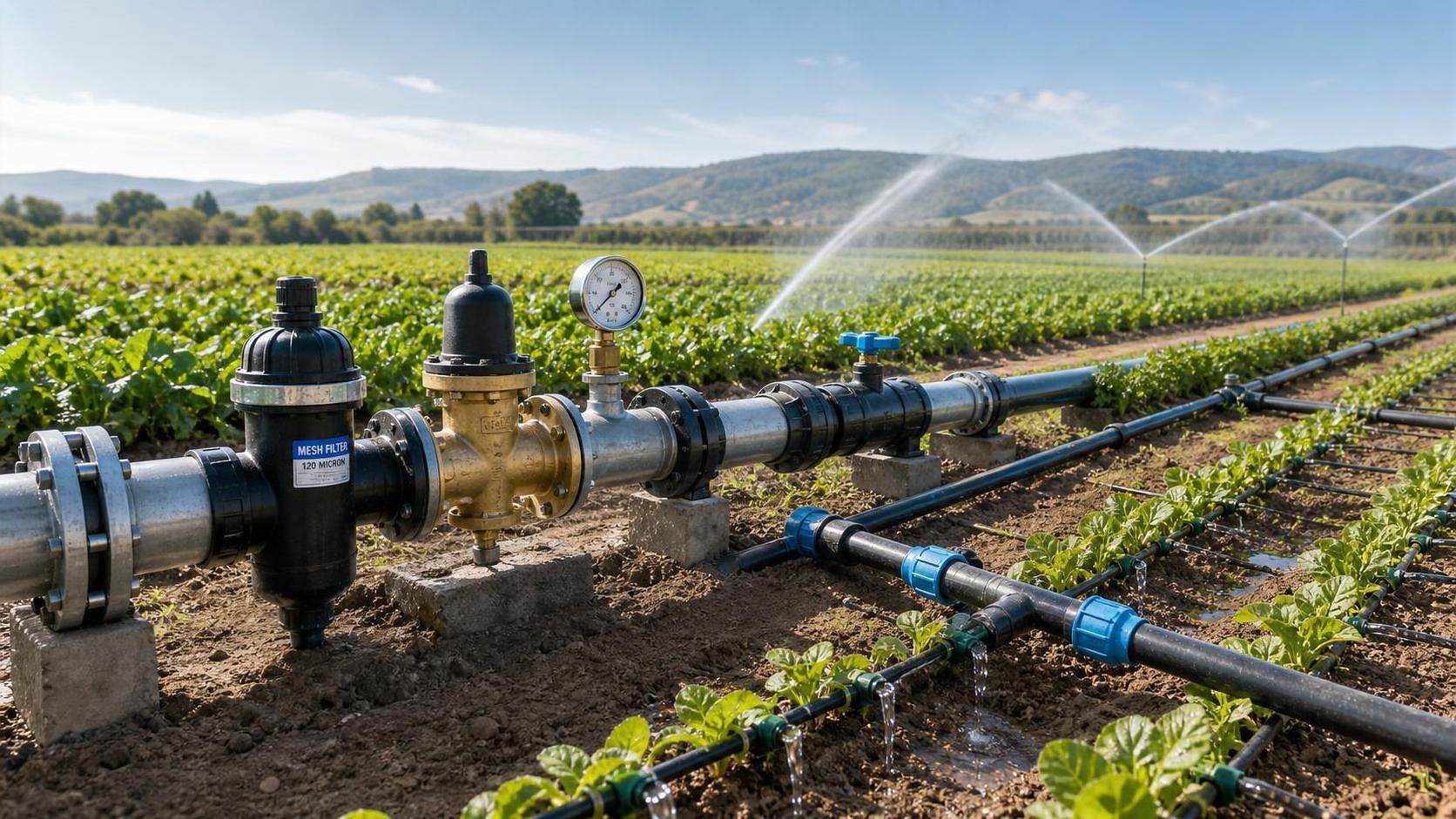
In most systems, these points matter most:
- Pump discharge.
- Before and after the main filter.
- Before and after pressure regulators.
- Beginning of the lateral line.
- End of the furthest lateral or zone.
These readings reveal where pressure is being lost.
Sometimes the setpoint is correct, but a blocked filter or undersized pipe changes the result.
In that situation, adjusting the controller alone will not fix stable flow.
Recent field upgrades show the same pattern.
Operators get better results when pressure data is collected during full-load irrigation, not during idle testing.
Match Pressure to System Type
Different irrigation systems need different intelligent irrigation equipment operating pressure strategies.
A drip network behaves very differently from a sprinkler line or pivot-fed section.
Drip Irrigation
Drip systems usually need lower pressure but tighter control.
Small changes can affect emitter output, especially in long laterals.
If pressure-compensating emitters are installed, confirm their working threshold before setting the regulator.
Sprinkler Irrigation
Sprinklers often need higher pressure to maintain throw radius and droplet pattern.
If intelligent irrigation equipment operating pressure is too low, overlap weakens and dry strips appear.
If it is too high, misting increases and wind drift becomes worse.
Mixed or Zoned Systems
Mixed systems need the most discipline.
Each zone may need a different setpoint because the hydraulic demand changes.
This is where smart controllers, zone valves, and variable frequency drives bring real value.
How to Set Pressure for Stable Flow in Practice
A practical setup process keeps intelligent irrigation equipment operating pressure stable under working conditions.
- Clean filters and flush lines before making adjustments.
- Run the target zone at normal flow demand.
- Record pressure at inlet, control point, and furthest outlet.
- Adjust the regulator or pump setpoint in small steps.
- Wait for readings to stabilize after each change.
- Check flow uniformity, not pressure alone.
- Repeat the test during the warmest part of the day if demand shifts.
This process sounds basic, but it catches most field-level errors.
More importantly, it links intelligent irrigation equipment operating pressure to real discharge performance.
That connection is what stable flow depends on.
Common Pressure Problems and What They Usually Mean
This table matters because pressure symptoms are often misread as simple pump issues.
In reality, intelligent irrigation equipment operating pressure is tied to the whole hydraulic chain.
How Smart Controls Help Maintain the Right Pressure
Modern systems can maintain intelligent irrigation equipment operating pressure with far less manual correction.
Pressure sensors, flow meters, and automation logic create a faster feedback loop.
The strongest setup usually includes:
- Real-time pressure monitoring at critical points.
- Variable speed pump control.
- Zone-specific pressure regulation.
- Alarm thresholds for sudden deviation.
- Historical trend review for preventive maintenance.
From an operational perspective, this reduces guesswork.
It also helps teams react before small pressure drift becomes yield loss or hardware damage.
That is increasingly important in water-saving irrigation systems, where every mismatch affects efficiency.
Final Pressure Setting Checklist
Before closing the job, use one final review.
- Confirm the target intelligent irrigation equipment operating pressure for each zone.
- Measure pressure during actual irrigation, not standby mode.
- Compare near-end and far-end flow performance.
- Review filter losses and regulator accuracy.
- Log the final setpoint for future maintenance.
The best intelligent irrigation equipment operating pressure is not simply the highest stable reading.
It is the lowest pressure that still delivers uniform flow, correct coverage, and dependable control response.
Set it with measurements, verify it under load, and review it as field conditions change.
That approach keeps intelligent irrigation equipment operating pressure aligned with stable flow, efficient water use, and longer system life.
Related News
Choosing a Digital Farming Platform Provider: Compatibility and Data Ownership
Compare digital farming platforms providers on equipment compatibility, data ownership, and export rights. Discover practical checks to avoid lock-in and choose with confidence.
How Large-Scale Farm Telematics Cuts Downtime Across Mixed Fleets
Large-scale farm equipment telematics cuts mixed-fleet downtime with real-time alerts, smarter maintenance, and stronger operational control. Learn how to protect critical farm workflows.
How to Size Low-Pressure Water-Saving Irrigation Systems for Uneven Fields
Low pressure water-saving irrigation systems for uneven fields: learn zoning, pressure mapping, pipe sizing, and pump selection to improve uniformity and reduce water waste.
Farm Machinery Sourcing: How to Vet Suppliers, Specs, and Lifecycle Costs
Farm machinery information for sourcing: learn to vet suppliers, compare specifications, control lifecycle costs, and secure reliable uptime for smarter equipment purchases.
Can hybrid propulsion systems reduce fuel use in farm machinery?
Hybrid propulsion systems for agricultural machinery can cut fuel use and boost productivity. Explore savings potential, key trade-offs, and smart investment factors.
What to compare in integrated seeding combinations for heavy soils
Compare integrated seeding combinations for heavy soils: depth control, residue flow, consolidation, traction, and field capacity for more uniform crop establishment.
When an integrated seeding combination improves field efficiency
Integrated seeding combination improves field efficiency, protects planting windows, and balances speed with seedbed quality, tractor capacity, and reliable establishment.
Which costs matter most when calculating precision agriculture ROI?
Calculating ROI on precision agriculture equipment? Discover the costs that shape returns, from installation and subscriptions to downtime, labor, and data integration.
How to calculate ROI on precision agriculture equipment before buying
Calculating ROI on precision agriculture equipment: learn to assess total ownership costs, savings, payback, NPV, risks, and farm-scale value before you buy.
Related News
- 00
0000-00
How to Size Low-Pressure Water-Saving Irrigation Systems for Uneven Fields - 00
0000-00
Drip vs. Micro-Sprinkler Irrigation: Which System Fits Your Orchard? - 00
0000-00
How to Select Smart Irrigation Valves for Multi-Zone Water Management? - 00
0000-00
Automated Water-Saving Irrigation: How to Cut Water Use Without Reducing Crop Yields - 00
0000-00
How to Evaluate Drip Irrigation System Manufacturers for Large Farm Projects
Popular Tags
Hydrological Resource Strategist
Weekly Insights
Stay ahead with our curated technology reports delivered every Monday.