
How Smart Agricultural Implements Use ISOBUS to Improve Precision and Equipment Compatibility




How Smart Agricultural Implements Use ISOBUS to Improve Precision and Equipment Compatibility
As farms demand tighter precision and easier machine integration, smart agricultural implements ISOBUS has become a critical topic for technical evaluators.
This matters even more in mixed fleets, where tractors, sprayers, seeders, spreaders, and balers often come from different brands.
Without a shared language, valuable field data stays trapped inside separate systems, and operators spend time solving connection issues instead of working.
ISOBUS changes that. It creates a common communication framework that helps machines exchange commands, settings, and job data with far less friction.
Why ISOBUS Matters in Smart Agricultural Implements
At its core, ISOBUS is based on ISO 11783, the global standard for electronic communication between tractors and agricultural implements.
In practical terms, smart agricultural implements ISOBUS allows one terminal, one connector, and one data structure to support many field tools.
That sounds simple, but the operational impact is substantial. Setup time drops, interface confusion declines, and machine behavior becomes easier to verify.
For technical assessment, the value is not only convenience. It is standardization of control logic, task execution, and machine-to-machine compatibility.
This also means procurement teams can compare equipment on measurable communication capability, not only horsepower, working width, or hydraulic demand.
The Shift from Standalone Implements to Connected Tools
Conventional implements mainly depended on mechanical adjustment and limited electrical signaling. Precision work required manual calibration and constant operator correction.
Today, connected implements use controllers, sensors, GPS guidance, rate maps, and feedback loops. That architecture needs stable digital communication.
ISOBUS provides that backbone, making smart agricultural implements ISOBUS a realistic option for scalable precision farming rather than a brand-specific experiment.
How ISOBUS Improves Precision in the Field
Precision gains begin with cleaner data exchange. When tractors and implements understand each other, commands arrive faster and are executed more consistently.
That directly affects seeding depth control, section shutoff, variable-rate fertilization, nozzle management, and application logging.
In actual operations, even small timing errors can create overlap, skips, wasted inputs, or uneven crop establishment across large acreages.
Key Precision Functions Supported by ISOBUS
- UT, or Universal Terminal, lets one in-cab display operate different implements through a common interface.
- TC, or Task Controller, manages application maps, job records, section control, and variable-rate execution.
- AUX-N enables shared auxiliary controls, reducing operator fatigue during repetitive or complex tasks.
- TIM, or Tractor Implement Management, allows the implement to trigger tractor functions during work cycles.
These functions turn smart agricultural implements ISOBUS into active participants in precision farming, rather than passive tools pulled behind the tractor.
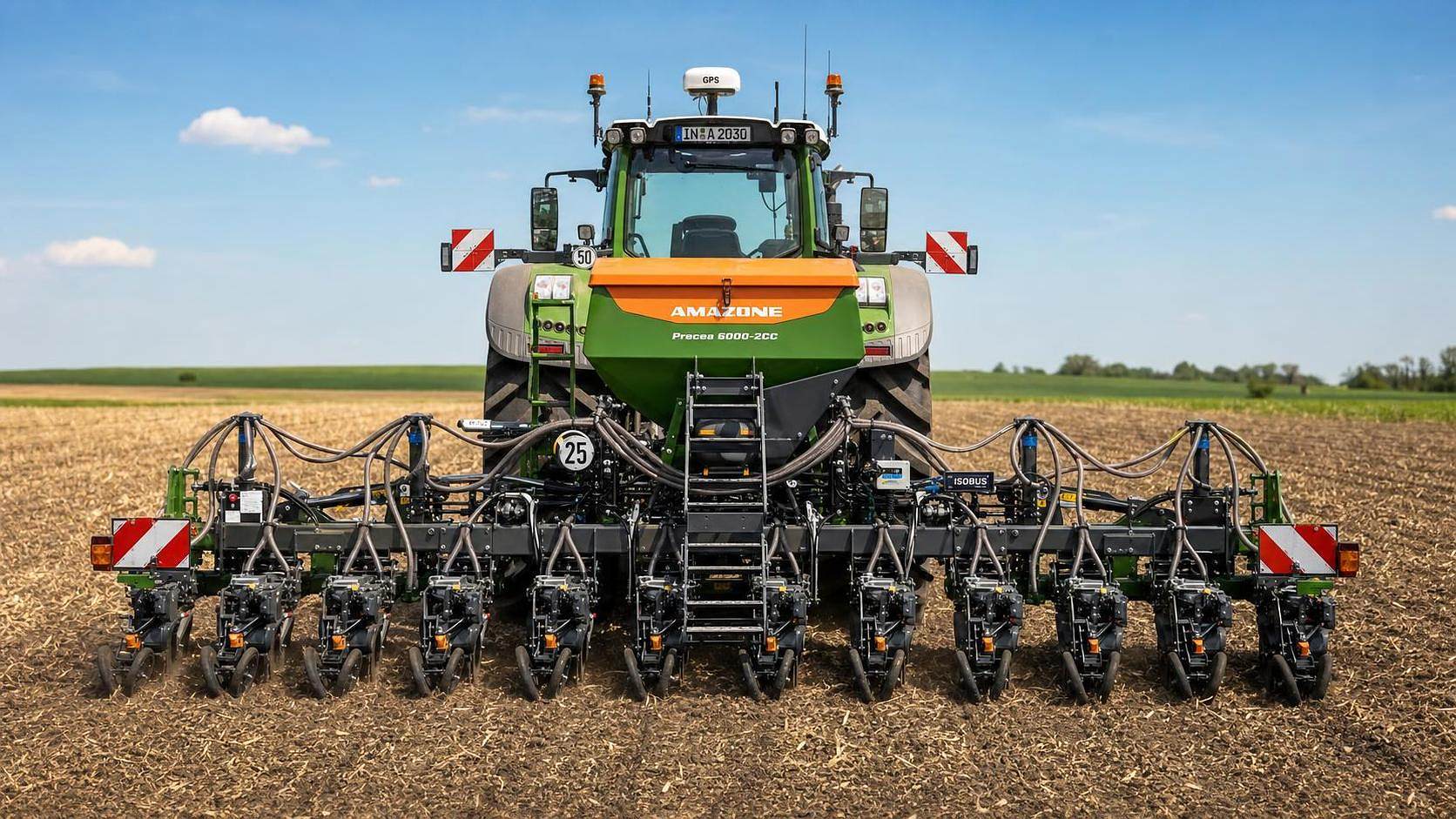
A planter can adjust population by zone. A spreader can follow nutrient prescriptions. A sprayer can stop overlapping sections at headlands automatically.
Why Better Precision Also Means Better Economics
Better control usually translates into lower input waste. Seeds, chemicals, fuel, and labor are used with less drift from the planned target.
More accurate execution also improves record quality. That strengthens traceability, agronomic analysis, and compliance with retailer or regulatory requirements.
For equipment evaluation, precision should therefore be measured as both agronomic performance and system-level cost control over multiple seasons.
How Smart Agricultural Implements ISOBUS Reduce Compatibility Risk
Compatibility is often the hidden cost in digital agriculture. Hardware may connect physically, yet data functions can still fail or behave inconsistently.
That is why the discussion around smart agricultural implements ISOBUS is really a discussion about interoperability assurance.
The standard reduces dependence on proprietary terminals and custom wiring, especially when fleets evolve through staggered purchases.
For operations running several brands, this lowers the risk of stranded capability, duplicate screens, and retraining every time a new implement arrives.
What to Verify Beyond the ISOBUS Label
Not every machine marketed as ISOBUS-ready supports the same functional depth. Basic display support is not equal to full task automation.
A disciplined evaluation should check:
- Which ISOBUS functions are certified, such as UT, TC-BAS, TC-SC, TC-GEO, AUX-N, or TIM.
- Whether the tractor terminal supports the same functions at the required software level.
- How firmware updates are managed across tractors, implements, receivers, and farm management software.
- Whether section control timing and rate response are validated under real travel speeds.
- How job data exports integrate with existing agronomic platforms and reporting workflows.
This is where technical diligence pays off. A nominal standard means little if implementation quality is weak or cross-brand testing is incomplete.
Field-Level Use Cases That Show Real ISOBUS Value
Variable-Rate Seeding
Prescription maps can be imported into the terminal, then sent through the Task Controller to the planter in real time.
The result is more stable population control across productivity zones, with better documentation of what was actually applied.
Section Control in Spraying
On irregular fields, automatic section switching limits overlap and protects margins already under cost pressure from chemical waste.
This function becomes especially valuable when working at night, under fatigue, or across operators with different experience levels.
Fertilizer Application with Mixed Fleets
A tractor from one manufacturer can operate a spreader from another, while still receiving maps, logging rates, and controlling section boundaries.
That flexibility is exactly why smart agricultural implements ISOBUS is gaining attention in multi-brand fleet planning.
A Practical Evaluation Framework for Technical Decision-Making
A useful review should move beyond brochure claims. The strongest equipment decisions come from function-by-function validation.
Start with five practical questions:
- Does the implement support the precision tasks required this season, not just future possibilities?
- Can current tractors and displays unlock those functions without extra controllers?
- Is setup repeatable across operators, shifts, and field conditions?
- Will the data output fit existing agronomy, compliance, and service workflows?
- What support model exists when software conflicts appear during peak season?
This approach helps separate marketing compatibility from operational compatibility. The difference becomes obvious once machines are under real workload.
It also aligns with the broader intelligence-driven view championed by AP-Strategy, where mechanical performance and digital interoperability are evaluated together.
Where ISOBUS Still Has Limits
ISOBUS is powerful, but it is not a shortcut around weak calibration, poor sensor quality, or incomplete operator training.
Response accuracy still depends on valve performance, application hardware, GPS reliability, and the speed of onboard controllers.
There can also be software interpretation differences between brands, especially with advanced automation functions or older machines.
So the right question is not whether smart agricultural implements ISOBUS solves everything. It is whether it reduces friction enough to justify standard adoption.
Final Takeaway for Smarter Equipment Selection
The strongest case for smart agricultural implements ISOBUS is clear: more precise control, cleaner data flow, and lower compatibility risk across diverse equipment fleets.
For modern agriculture, that combination supports better field execution and more defensible investment decisions over the long term.
When evaluating new implements, focus on certified functions, cross-brand behavior, data integration, and response quality under real operating conditions.
That is where the real value of ISOBUS appears, and where precision agriculture moves from concept into repeatable performance.
In a market shaped by efficiency, traceability, and sustainability, standard-based interoperability is no longer optional. It is becoming core equipment logic.
Related News
Choosing Drip Irrigation Systems for Open Fields: Soil, Slope, and Water Quality
Choose drip irrigation systems for open fields with confidence. Discover how soil, slope, and water quality shape emitter spacing, pressure, and filtration—and avoid costly design mistakes.
Choosing Crop Protection Equipment for Hot, Windy Middle Eastern Farms
Compare crop protection equipment Middle East farms need for hot, windy conditions. Discover key nozzle, drift-control, and durability checks to choose the right sprayer.
Choosing an Agriculture 4.0 Supplier: Compatibility, Support, and Total Cost
Choose an Agriculture 4.0 supplier with confidence. Learn how to verify compatibility, assess support, and compare total ownership costs to avoid hidden fees and costly downtime.
Low-Pressure Drip Irrigation: How to Fix Uneven Watering Without Raising Pressure
Optimize low pressure water-saving irrigation systems: discover how to fix uneven watering, clear blockages, and reduce hydraulic losses without raising supply pressure.
Comparing Farm Equipment Supplier Quotes: Price, Freight, and Warranty
Simplify supplier comparison for farm equipment price: assess freight, field-ready costs, and warranty coverage. Learn how to avoid hidden charges and choose a reliable supplier.
Choosing a Digital Farming Platform Provider: Compatibility and Data Ownership
Compare digital farming platforms providers on equipment compatibility, data ownership, and export rights. Discover practical checks to avoid lock-in and choose with confidence.
How Large-Scale Farm Telematics Cuts Downtime Across Mixed Fleets
Large-scale farm equipment telematics cuts mixed-fleet downtime with real-time alerts, smarter maintenance, and stronger operational control. Learn how to protect critical farm workflows.
How to Size Low-Pressure Water-Saving Irrigation Systems for Uneven Fields
Low pressure water-saving irrigation systems for uneven fields: learn zoning, pressure mapping, pipe sizing, and pump selection to improve uniformity and reduce water waste.
Farm Machinery Sourcing: How to Vet Suppliers, Specs, and Lifecycle Costs
Farm machinery information for sourcing: learn to vet suppliers, compare specifications, control lifecycle costs, and secure reliable uptime for smarter equipment purchases.
Related News
- 00
0000-00
When digital crop monitoring detects stress before visible damage - 00
0000-00
How to Evaluate Dynamic Feedback Algorithm Suppliers for Precision Farming Systems - 00
0000-00
How Sensor Feedback Enables Accurate Variable-Rate Fertilization in Field Conditions - 00
0000-00
How to Select Precision Crop Protection Equipment for Variable Field Conditions - 00
0000-00
How to Evaluate Precision Fertilization System Suppliers for Farm-Scale Deployment
Popular Tags
Tractor Power Architect
Weekly Insights
Stay ahead with our curated technology reports delivered every Monday.