
EN 17892-3:2026 Enforced: EMC Immunity Now Mandatory for Soil Moisture Sensors Entering EU
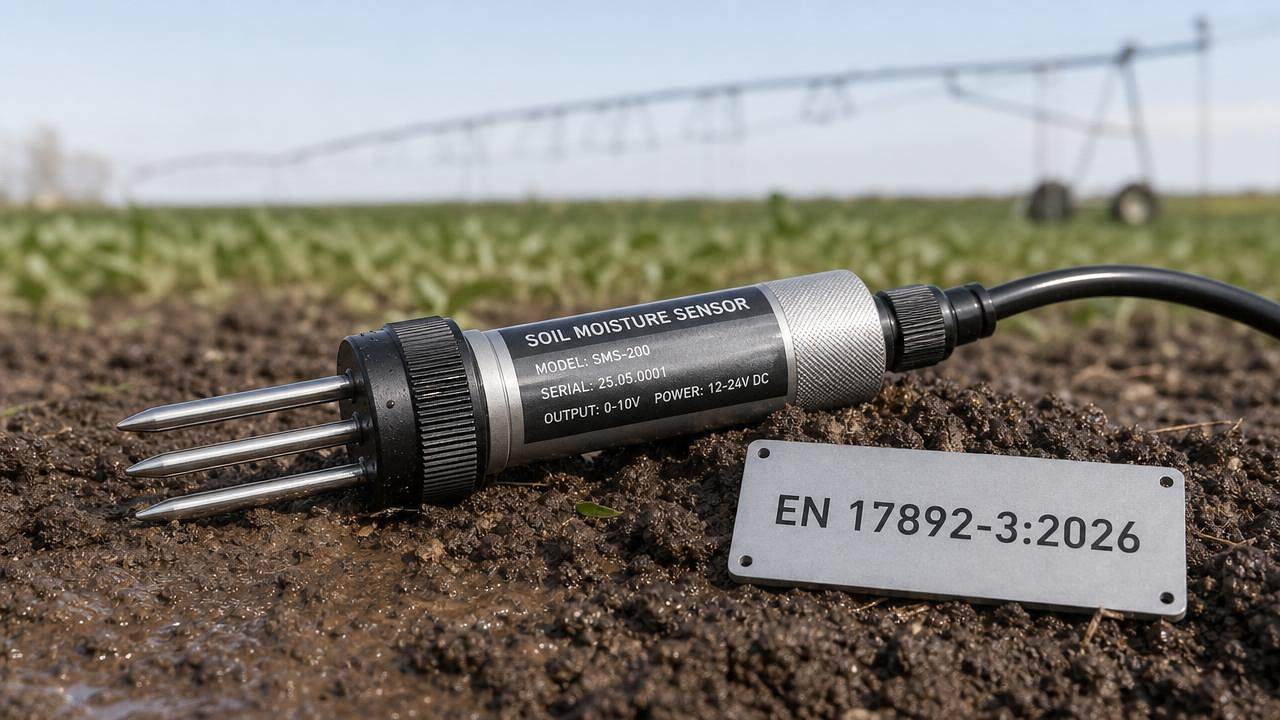




On 19 May 2026, the European Committee for Standardization (CEN) formally enforced EN 17892-3:2026 — a new harmonized standard specifying electromagnetic compatibility (EMC) immunity requirements for soil moisture sensors. This regulation applies immediately to all products placed on the EU market, triggering urgent compliance reviews across global supply chains, particularly among Chinese exporters serving precision agriculture and environmental monitoring sectors.
Event Overview
EN 17892-3:2026 entered into mandatory force on 19 May 2026. It establishes stringent electromagnetic immunity test criteria — including electrostatic discharge (ESD), radiated RF fields, and fast transient bursts — that soil moisture sensors must pass prior to EU customs clearance. Products bearing CE marking under previous directives or older versions of EN 61326 (e.g., EN 61326-1:2013) are no longer sufficient unless specifically re-evaluated against EN 17892-3:2026’s updated test profiles and performance thresholds.
Industries Affected
Direct trading enterprises face immediate shipment delays and potential customs rejection if their current inventory lacks valid EN 17892-3:2026 test reports. Since conformity assessment is now tied to customs entry, documentation gaps directly impact delivery timelines, contractual penalties, and buyer trust — especially in time-sensitive agricultural deployment windows (e.g., spring planting cycles).
Raw material procurement enterprises are affected indirectly but significantly: suppliers of critical components — such as RF-shielded enclosures, low-noise analog front-ends, and ESD-protected signal conditioning ICs — are now receiving revised technical specifications from sensor OEMs. Delays in qualifying new component batches against enhanced EMC requirements may constrain bill-of-materials flexibility and increase lead times.
Manufacturing enterprises must reassess product design, PCB layout, shielding strategies, and firmware-level noise filtering. Retesting legacy models often reveals failures in radiated immunity above 80 MHz or susceptibility during ESD events at I/O ports — issues not captured under prior standards. This triggers engineering revisions, prototype revalidation, and extended time-to-market for updated SKUs.
Supply chain service enterprises, including notified bodies, EMC test laboratories, and regulatory consultants, are observing surging demand for gap analysis, pre-compliance screening, and expedited test scheduling. Capacity constraints at accredited labs in China and EU-based facilities have already led to wait times exceeding six weeks for full EN 17892-3:2026 test suites — raising urgency around early engagement and staged validation planning.
Key Focus Areas and Recommended Actions
Verify existing CE documentation scope
Enterprises should audit whether their current CE Declarations of Conformity explicitly reference EN 17892-3:2026 or rely solely on superseded standards (e.g., EN 61326-1). If the latter, formal technical file updates and third-party re-assessment are required — not merely a document revision.
Prioritize products with high-volume EU shipments
Given limited lab capacity and variable test durations (typically 5–12 working days per unit depending on configuration), companies should triage models by annual EU import volume and customer contractual obligations — focusing first on top-three SKUs accounting for >70% of EU-bound units.
Engage notified bodies early for transitional arrangements
While the standard is mandatory as of 19 May 2026, some notified bodies offer phased verification pathways — e.g., accepting partial test evidence (such as pre-scan emissions data or component-level immunity reports) to accelerate final certification. These options require proactive coordination and are not universally available.
Review labeling and user documentation
EN 17892-3:2026 mandates updated user instructions highlighting installation conditions affecting EMC performance (e.g., cable routing, grounding practices, proximity to RF sources). Non-compliant manuals may invalidate otherwise compliant hardware under post-market surveillance.
Editorial Perspective / Industry Observation
Observably, EN 17892-3:2026 reflects a broader regulatory shift: from generic EMC frameworks toward application-specific, risk-informed immunity benchmarks. Its focus on real-world field stressors — such as switching transients from nearby irrigation controllers or GSM interference in rural deployments — signals growing alignment between EU standardization and operational reliability expectations. Analysis shows this trend is likely to extend to other environmental sensor categories (e.g., soil pH, nitrogen sensors) in upcoming revisions of EN 17892 series standards. From an industry perspective, this is less a one-off compliance hurdle and more a structural inflection point — where electromagnetic resilience transitions from a ‘certification checkbox’ to a core product differentiator.
Conclusion
The enforcement of EN 17892-3:2026 underscores how regional technical regulations increasingly shape global product development cycles — not only for safety and interoperability, but for functional robustness in complex electromagnetic environments. For sensor manufacturers and their partners, sustained competitiveness will depend less on reacting to individual standards and more on embedding EMC-aware design disciplines across R&D, sourcing, and quality assurance functions. A rational interpretation is that this standard accelerates consolidation among suppliers capable of systematic EMC management — rather than fragmenting the market through short-term compliance firefighting.
Source Attribution
Official text published by CEN (CEN/TC 231/WG 12): www.cen.eu; EU Official Journal reference: OJ L 142/2026. Notified body guidance issued by TÜV Rheinland and SGS on 12 April 2026 (publicly accessible via respective technical bulletins). Pending clarification: Whether legacy stock manufactured before 19 May 2026 but cleared post-enforcement remains exempt — subject to national market surveillance authority discretion. To be monitored closely over Q3 2026.
Related News
How to Select Smart Irrigation Valves for Multi-Zone Water Management?
Intelligent irrigation systems valves: learn how to match smart valves with multi-zone flow, pressure, control, feedback, and communication needs for reliable water management.

Climate-Smart Farming for Drought: A Practical Plan for Protecting Yields
Climate-smart farming for drought: build smarter water budgets, protect critical crop stages, improve irrigation uniformity, and safeguard yields with practical field-proven strategies.

How Digital Agriculture Platforms Turn Field Data Into Better Input Decisions
Digital agriculture platforms turn field data into smarter fertilizer, water, seed, and equipment decisions—helping farms cut risk, improve margins, and scale sustainability.

GPS-Guided Farm Machinery: Where It Delivers Measurable Field Efficiency Gains
Agri-mechanization GPS guided systems deliver measurable field efficiency gains through reduced overlap, precise planting, smarter inputs, and reliable farm data.

How Sensor Feedback Enables Accurate Variable-Rate Fertilization in Field Conditions
Precision fertilization systems with sensor feedback improve variable-rate accuracy by verifying flow, managing latency, and ensuring reliable field application.

How to Select Precision Crop Protection Equipment for Variable Field Conditions
Precision crop protection equipment selection made simple: compare terrain, canopy, weather, control accuracy, and data workflows for reliable applications.

When Does Agricultural Machinery Leasing Cost Less Than Owning Equipment?
Agricultural machinery leasing can lower farm costs when use is seasonal or uncertain. Compare utilization, maintenance, cash flow, and risk to make a smarter equipment decision.

How to Evaluate Precision Fertilization System Suppliers for Farm-Scale Deployment
Precision fertilization systems suppliers: learn how to compare accuracy, integration, uptime, service, and total cost for confident farm-scale deployment.

ISOBUS for Smart Agriculture: How It Connects Tractors, Implements, and Farm Data
ISOBUS for smart agriculture connects tractors, implements, terminals, and farm data—helping growers improve precision, documentation, and smarter field decisions.
Related News
- 00
0000-00
Climate-Smart Farming for Drought: A Practical Plan for Protecting Yields - 00
0000-00
Selecting Real-Time Soil Moisture Sensors for Irrigation Zone Control - 00
0000-00
How Does Climate-Smart Farming Reduce Water Use in Semi-Arid Areas? - 00
0000-00
USDA Rule Takes Effect: Dual FCC and NRCS Approval for Soil Moisture Sensors - 00
0000-00
EU Rule Takes Effect: Soil Moisture Sensors Need Revised CE-EMC Certification
Popular Tags
Hydrological Resource Strategist
Weekly Insights
Stay ahead with our curated technology reports delivered every Monday.