Choosing Smart Irrigation Equipment for Orchards With Existing Drip Systems




Choosing Smart Irrigation Equipment for Orchards With Existing Drip Systems
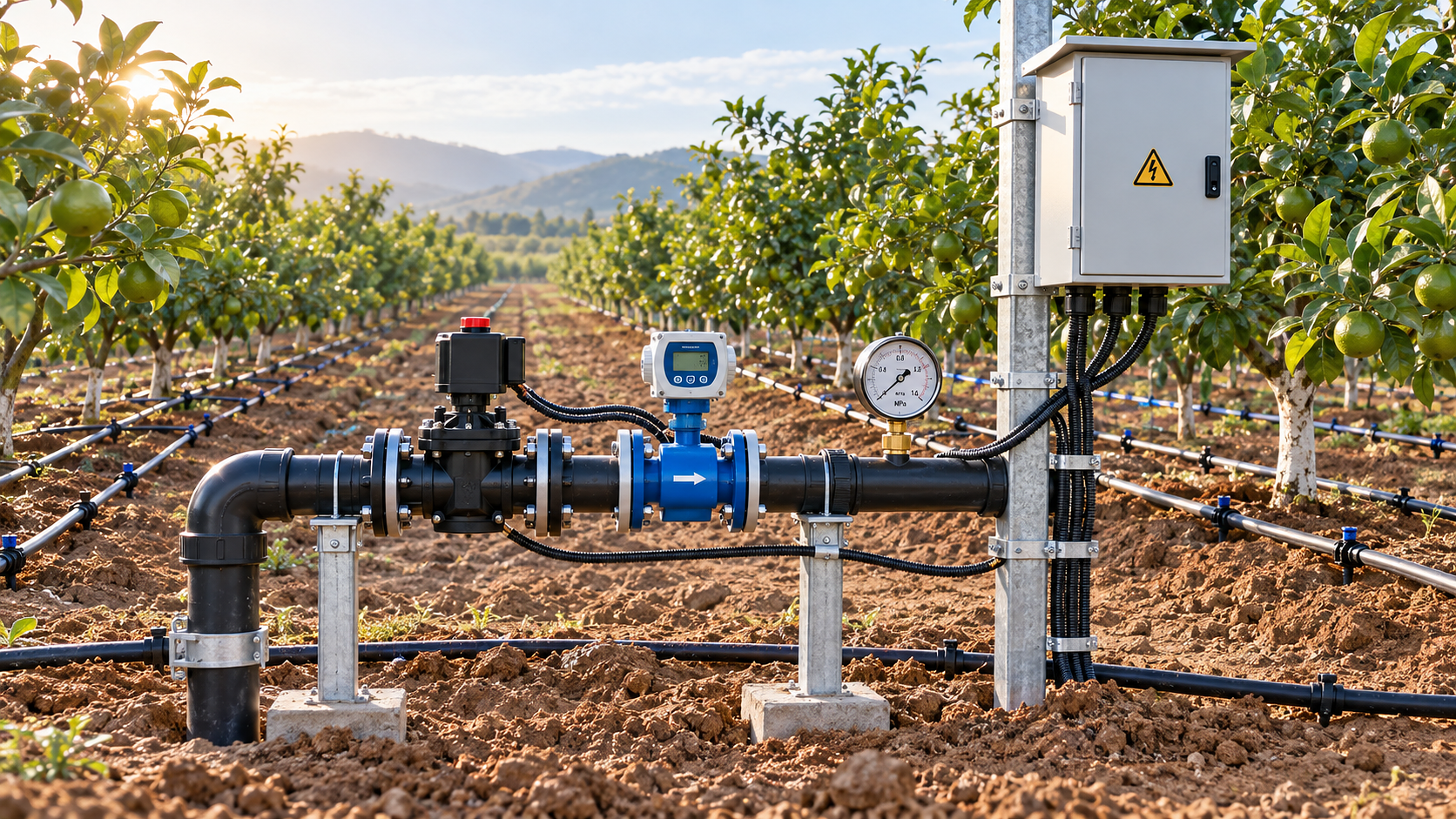
Upgrading an orchard’s existing drip system should improve irrigation decisions—not create costly compatibility problems. Choosing intelligent irrigation equipment for orchards means assessing more than sensors and remote controls: hydraulic capacity, valve compatibility, connectivity, and data integration all influence retrofit performance. The aim is to deliver water more precisely, expose operational faults, and retain serviceable infrastructure rather than replace it unnecessarily.
The most useful distinction is between a system that follows a schedule remotely and one that verifies what happened in the field. A controller may report that a valve opened without knowing whether water reached the trees. That gap should shape the equipment specification from the start.
Establish what the existing drip system can actually deliver
Before comparing platforms, assemble a working block map: pump and filter arrangement, mainline routes, elevation changes, valve locations, lateral lengths, emitter specifications, and permitted operating combinations. Check the map against the orchard. Repairs, replacement emitters, and undocumented extensions can make an old design drawing misleading.
Measure pressure and flow under representative operating conditions, including the most hydraulically demanding combinations. Sample emitter discharge across selected laterals, especially near their ends and at different elevations. Pressure-compensating emitters still require operation within their specified pressure range; they cannot correct every supply or blockage problem.
Consider a hillside block where upper rows receive less water than lower rows. A moisture sensor near the upper rows may repeatedly request longer irrigation. That could overwater the lower rows without fixing the pressure imbalance. The appropriate intervention may be hydraulic correction or separate zoning—not a more sophisticated scheduling algorithm.
Keep sound pipework, filters, regulators, and emitters where testing supports doing so. But resolve persistent clogging, leakage, and inadequate pressure before allowing automatic scheduling to compensate for them.
Check compatibility at the valve, pump, and filter—not just the dashboard
An existing electrically operated valve is not automatically compatible with a new controller. Confirm solenoid voltage, AC or DC operation, latching requirements, current demand, cable condition, and allowable cable distance. Battery-powered field nodes commonly use latching solenoids, but the specific controller and valve combination must be verified.
Also distinguish the electrical command from hydraulic actuation. A solenoid can operate while a valve remains partly closed because of a pilot-line problem, insufficient pressure differential, or diaphragm damage. Flow and pressure feedback help reveal this; an “open” icon alone does not.
Request a written interface schedule before purchase:
- Controller outputs matched to each valve and pump interface.
- Sensor inputs identified by signal type, range, power requirement, and calibration method.
- Pump start, valve sequencing, and variable-speed drive responsibilities clearly assigned.
- Filter backwash and fertigation interlocks documented, including behavior after power loss.
Avoid connecting a new controller directly to pump equipment without confirming the required interface and protection arrangements with qualified personnel. A scheduling platform should not bypass dry-run protection, motor safeguards, or existing pressure controls. Fertilizer injection also needs verified water flow and appropriate backflow protection; the applicable requirements depend on the installation and local rules.
Use flow and pressure to make irrigation observable
For an orchard with little instrumentation, flow measurement and selected pressure monitoring often deserve priority over fully autonomous scheduling. They answer a basic question: did the requested irrigation event produce a plausible hydraulic response?
A mainline meter can identify abnormal total demand, but it may not identify the affected block when several valves operate together. Block-level metering offers better fault localization at additional installation and maintenance cost. The choice depends on operating combinations, block value, and how quickly staff need to isolate failures.
Select a meter for the actual operating flow range, not pipe diameter alone. Verify pressure loss, water-quality suitability, installation orientation, upstream and downstream pipe requirements, and controller resolution. At low flow, a coarse pulse output may delay detection of a short irrigation event.
Alarm logic needs context. High flow may indicate a broken lateral, but it may also reflect an authorized flushing event. Low flow could result from clogging, a partly opened valve, or reduced supply pressure. Establish normal flow and pressure signatures for each approved valve combination, then allow for startup transients and filter backwashing before triggering an alarm or shutdown.
Choose moisture monitoring around orchard variability
Soil-moisture monitoring is valuable when the installation represents the management question. One convenient probe beside an access road cannot reliably describe a block containing contrasting soils, slopes, rootstocks, or tree ages.
Group monitoring locations by meaningful differences in soil and crop conditions. Within each location, confirm the wetted pattern and active rooting depth before choosing sensor positions. A probe immediately below an emitter may show rapid wetting while missing dry soil elsewhere in the root zone. One outside the wetted bulb may suggest insufficient irrigation even when the intended root zone is adequately supplied.
Volumetric water-content sensors and soil-water-tension sensors provide different information. Water-content readings help track storage changes, while tension indicates how strongly water is held in the soil. Selection should consider soil properties, useful measurement range, salinity sensitivity where relevant, installation quality, and maintenance needs—not simply dashboard appearance.
Monitoring at multiple depths can show whether an event wets the intended root zone or sends water below it. Even so, thresholds require field interpretation. A sudden reading change may reflect irrigation, poor sensor contact, disturbance, or sensor failure. Do not let a single unverified value control an entire block.
Weather-based scheduling should remain bounded
Reference evapotranspiration can inform crop-water estimates, but orchard demand also depends on canopy development, crop stage, effective rainfall, and local conditions. Ask whether the platform exposes its crop coefficients and adjustment logic. A recommendation is difficult to evaluate if its assumptions are hidden.
Use weather estimates alongside soil trends and field observations. Set maximum event duration, minimum intervals where appropriate, and limits on simultaneous valves. If the orchard uses regulated deficit irrigation, confirm that the platform supports deliberate stage-specific targets rather than automatically correcting every moisture decline.
Test connectivity where the equipment will operate
A strong signal at the pump house does not establish coverage inside the orchard. Terrain, wet foliage, metal enclosures, antenna placement, and seasonal canopy growth can affect communication. Survey the actual valve and sensor locations, and repeat checks under representative conditions where practical.
Cellular, private radio, and low-power wide-area networks each involve trade-offs in coverage, power demand, infrastructure, and recurring fees. Protocol names alone do not demonstrate reliability. Request evidence of successful communication at the proposed locations and inspect how the system handles delayed or missing messages.
The important demonstration is often an outage test. Disconnect the internet connection and confirm what continues locally. Does the controller retain an approved schedule? Are readings buffered? Can an operator stop irrigation without cloud access? What happens when communication returns?
There is no universal safe fallback. Closing valves may reduce flooding risk but interrupt necessary watering; continuing indefinitely creates a different hazard. Specify behavior separately for lost communications, failed sensors, low battery, and power interruption. Include manual operation, access permissions, and a record of local overrides.
Buy usable information, not a closed data stream
Ask suppliers to demonstrate data export rather than merely confirm that it exists. Useful records include timestamps, units, sensor identity, quality flags, valve commands, measured flow, and alarm acknowledgments. Check whether historical data remains accessible after a subscription ends and whether an API is included or separately charged.
If records must feed farm-management software, verify time zones, naming conventions, update intervals, and how missing values are represented. Data integration fails surprisingly easily when one system reports cumulative meter totals and another expects interval volumes.
AP-Strategy’s focus on the connection between machinery performance, precision algorithms, and resource use offers a useful evaluation lens here: a recommendation has limited value unless the physical system can execute it and measurements can verify it. More connected devices do not necessarily mean better irrigation decisions.
Make the purchase conditional on a field pilot
Pilot the proposed equipment on a block that exposes meaningful difficulty—such as elevation variation, weak connectivity, or mixed soil—not only the easiest block near the office. Begin with monitoring and operator-approved recommendations before enabling closed-loop control.
Agree on acceptance criteria before installation. These should cover verified valve operation, meter performance, communication continuity, alarm usefulness, outage recovery, and staff workload. Test abnormal conditions safely through controlled simulations. Do not assume a successful dashboard demonstration proves field reliability.
Compare total installed and operating cost: interfaces, trenching, antennas, subscriptions, batteries, calibration, replacements, training, and technical support. Evaluate water and energy use against a documented baseline, accounting for weather, production conditions, and starting soil moisture. Lower water application alone does not establish better performance if trees were under-irrigated.
The strongest retrofit is usually the one that closes a specific operational gap with the least unnecessary complexity. If delivery is uncertain, improve measurement. If decisions are inconsistent, add better scheduling support. Expand automation only after the pilot shows that commands, water delivery, and field response agree—and that staff can diagnose the system when they do not.
Related News
Agricultural Automation Still Needs Human Oversight, Study Finds
Agricultural automation still needs human oversight. Discover how AI and smart equipment are reshaping farm jobs, skills, and decisions.
Choosing a Precision Fertilization Equipment Manufacturer: What to Check
Choose a precision fertilization equipment manufacturer with confidence. Compare accuracy, compatibility, service and total ownership costs before you buy.
China's Autumn Grain Harvest Highlights Role of Machinery and Precision Farming
China's autumn grain harvest highlights machinery and precision farming. Explore how coordinated practices support harvesting and yield improvement.
Drip vs. Center Pivot Irrigation: Maintenance Tasks and Costs Compared
Use this irrigation solution comparison by maintenance to weigh drip vs. center pivot tasks, costs and downtime—and choose the best fit for your field.
EIMA 2026: Six Tractor of the Year Awards Include Autonomous Robot
Explore the Tractor of the Year awards at EIMA 2026, featuring six winners, including the AgXeed autonomous robot and leading tractor models.
Choosing Irrigation Systems for Government Projects: Water, Cost and Compliance
What factors affect irrigation system selection for government projects? Explore water supply, lifecycle costs and compliance to make a confident, well-informed choice.
Choosing an Agricultural Machinery Platform: Listings, Pricing, and Support
Choosing an agricultural machinery platform? Compare listings, pricing, supplier verification, and support to make a more confident equipment purchase.
Ofwat Launches £8 Million Agri-Water Innovation Challenge
Ofwat’s £8 million Agri-Water Innovation Challenge supports smart irrigation, water reuse and water-saving solutions. Explore the funding and its potential impact.
Choosing a Water-Saving Irrigation Supplier: 5 Key Procurement Criteria
Choose a water-saving irrigation systems supplier with confidence. Explore five procurement criteria to reduce risk and maximize long-term value.
Related News
- 00
0000-00
Drip vs. Center Pivot Irrigation: Which Saves More Water for Your Farm? - 00
0000-00
Low-Pressure Drip Irrigation: Choosing Emitters to Save Water and Maintain Uniformity - 00
0000-00
Choosing Smart Irrigation Equipment for Orchards With Existing Drip Systems - 00
0000-00
Smart Irrigation Equipment for Drip Systems: Key Compatibility Checks - 00
0000-00
Choosing Drip Irrigation Systems for Open Fields: Soil, Slope, and Water Quality
0000-00
Popular Tags
Hydrological Resource Strategist
Weekly Insights
Stay ahead with our curated technology reports delivered every Monday.