Is GPS RTK precision agriculture accurate enough for row planting?
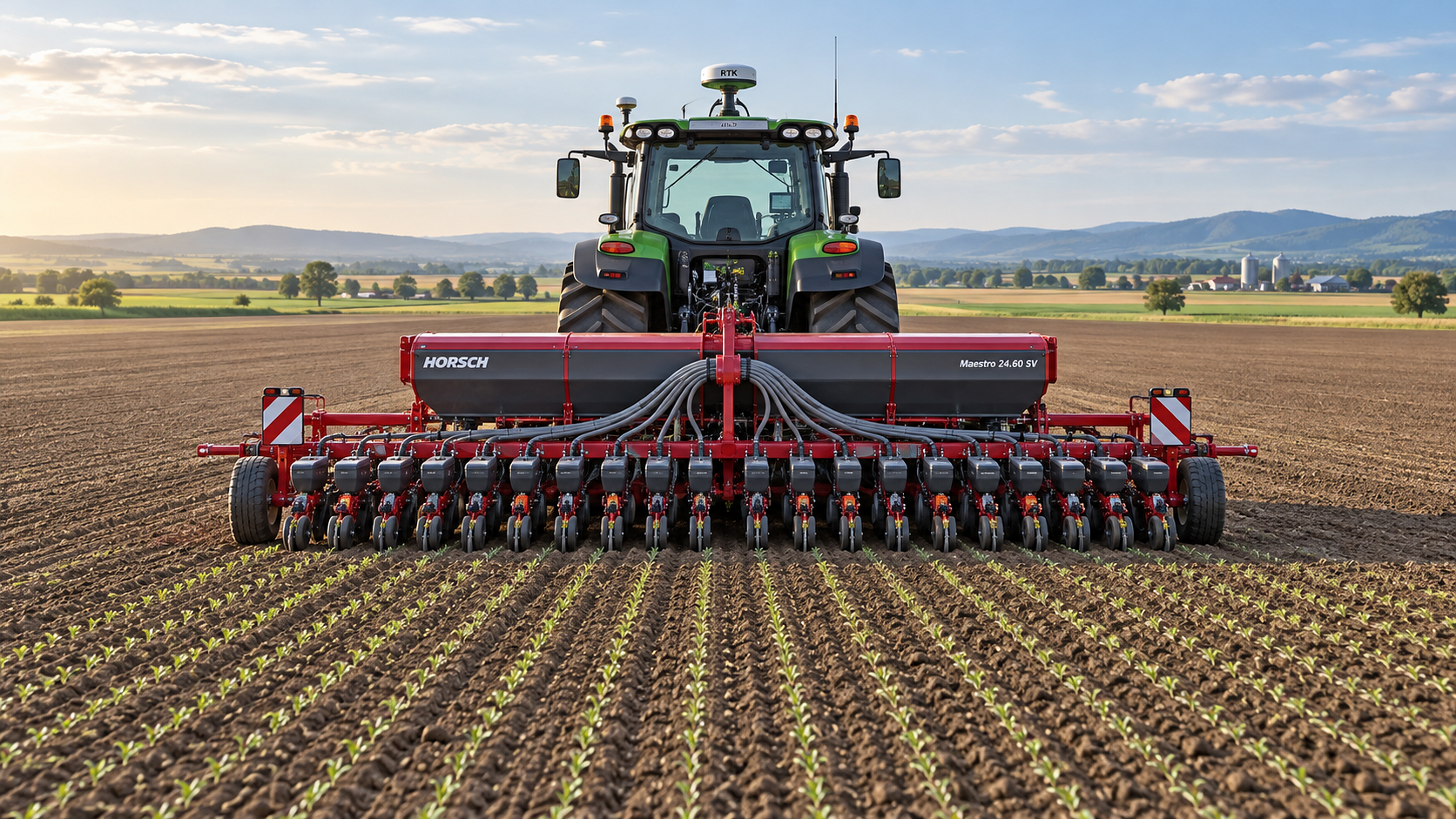




Yes, GPS RTK precision agriculture is accurate enough for row planting when the entire guidance chain is set up and maintained to the same standard as the positioning system. RTK corrections can support repeatable pass-to-pass guidance at the centimeter level, which is sufficient for most row-crop operations. The qualification matters: a receiver reporting an RTK-fixed position does not prove that the planter toolbar, seed openers, and actual seed rows are aligned to that position. Row placement is the combined result of correction integrity, antenna geometry, steering performance, implement control, field conditions, and soil interaction.
For row planting, the useful question is not whether the display holds a guidance line. It is whether adjacent planted rows maintain the intended spacing and whether that geometry remains repeatable for later operations such as cultivation, banded fertilization, spraying, controlled traffic, and harvest. A system can look stable on the screen while the implement drifts, swings, or shifts enough to create inconsistent row centers.
What RTK Accuracy Means at Planting Depth
RTK uses carrier-phase corrections from a fixed reference source or a correction network to resolve the position of the GNSS antenna with far greater precision than standalone satellite guidance. Under a healthy fixed solution, the tractor position can be both accurate and repeatable enough to establish row geometry. Repeatability is often more valuable than an isolated absolute coordinate because planting, cultivation, and harvesting may need to return to the same field reference over separate days or seasons.
However, the antenna is usually mounted above and ahead of the point where seed enters the soil. The guidance controller must convert antenna position into the intended path of the tractor, while the planter follows behind through a drawbar, three-point linkage, or hitch. Every mechanical relationship after the antenna introduces its own error source. A few centimeters of lateral variation may be insignificant for broad-acre spreading, yet it can matter greatly where narrow row spacing leaves little tolerance between planted rows and a later mechanical tool.
RTK performance should therefore be evaluated in three layers:
- Position solution: whether the receiver consistently holds an RTK-fixed solution with low correction age and no recurring interruption along the planned operating area.
- Vehicle path: whether the tractor follows the commanded line without steady offset, oscillation, delayed correction, or excessive cross-track error at planting speed.
- Seed-row result: whether opener paths remain centered at the required spacing after the toolbar enters the soil, crosses uneven ground, and encounters changing draft forces.
A pass can satisfy the first layer while failing the third. This distinction prevents a common purchasing error: comparing receiver accuracy specifications without examining the steering system and planter behavior that determine the finished row.
Correction Reliability Is a Field Requirement
Correction delivery is often treated as a communications detail, but a row-planting system is only as repeatable as its correction source remains stable. A local base station, radio link, or network correction service can all be suitable when coverage, latency, and reference continuity fit the field layout. The relevant test is not simply whether a correction signal is visible at the yard. It is whether the receiver remains fixed at field edges, in low areas, beside shelterbelts, and during the working period when the planter is operating.
Signal blockage and multipath deserve separate attention. Blockage occurs when foliage, terrain, buildings, or machine structures restrict the satellite view. Multipath occurs when satellite signals reflect from surfaces before reaching the antenna, causing the receiver to interpret a distorted path. Both can degrade a solution, but their symptoms differ. Blockage often produces a loss of fix or longer convergence after interruption. Multipath may produce position wandering even though the receiver remains connected and the guidance display appears operational.
A correction stream with excessive latency can create a different problem. The receiver may still show a fixed state, yet rapid steering adjustments can lag behind the actual tractor motion. This is more visible at higher planting speeds, on curved headlands, or where the tractor crosses short rolling terrain. Correction age, network availability, and loss-of-fix recovery behavior should be logged during a representative field pass instead of judged from a stationary setup screen.
The Implement Can Be Less Accurate Than the Tractor
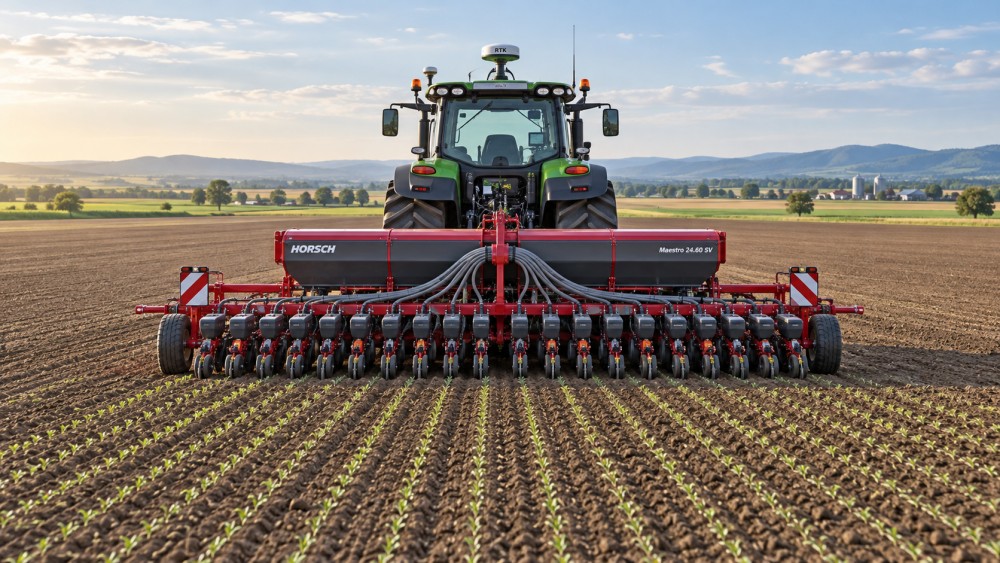
Planter offset calibration is a foundational task. The system needs the correct longitudinal distance from the antenna reference point to the effective planting line, as well as any lateral offset between the tractor centerline and the implement centerline. Incorrect dimensions create a consistent positional error. This can be mistaken for RTK inaccuracy because each pass may be consistently wrong by the same amount.
Fixed offset is easier to diagnose than dynamic offset. Dynamic offset changes while the machine works. A mounted planter can move laterally as the hitch responds to slope, draft, or hydraulic play. A trailed planter can crab behind the tractor on side slopes or in loose residue. A folding toolbar can flex, particularly when outer wing sections encounter different soil resistance. Row units may track differently across the width of a large planter when one side runs in firmer soil or deeper residue.
Active implement guidance is most relevant where soil conditions or terrain cause the planter to move sideways relative to the tractor. Its value is not that it improves satellite accuracy; it keeps the implement aligned with the established reference path. This distinction affects specification decisions. If the tractor has stable RTK guidance but the planter repeatedly moves off line on slopes, purchasing a receiver with a tighter stated position specification will not correct the underlying geometry.
Steering Quality Changes With Speed and Soil
Autosteer does not produce a single accuracy value that applies to every operation. A machine that follows an AB line smoothly at a moderate speed on level, firm ground may hunt from side to side when speed increases or the front tires run through soft tilled soil. Hydraulic steering response, steering valve calibration, wheelbase, tire construction, ballast, and front-axle loading all affect how quickly the tractor corrects a deviation.
Over-aggressive steering gain can lead to visible oscillation: the tractor repeatedly crosses the target line because each correction is too large or arrives too late. Low gain creates a lazy response that allows the tractor to remain off line for too long. Both conditions may leave rows that look broadly parallel while producing unacceptable variation in the actual seed centers. A stable control setting should be established at realistic planting speed, with the planter loaded and engaged, rather than during a light transport or setup pass.
Wheel slip requires a separate interpretation. RTK position does not rely on wheel rotation for its coordinate solution, but vehicle dynamics still change when tires lose lateral or longitudinal grip. On a slope, the tractor may yaw or slide before the steering system recovers. In wet conditions, tire tracks can create a misleading visual reference because the vehicle body and planter do not necessarily travel along the same path as the most visible wheel marks.
Terrain, Seedbed Condition, and Row-Unit Mechanics
RTK cannot remove soil-induced movement. In a firm, uniform seedbed, opener assemblies tend to maintain a more predictable path. In uneven residue, ridge-till ground, cloddy prepared soil, or fields with abrupt changes in moisture, individual row units can deflect around resistance. Gauge wheels, disc openers, closing wheels, parallel linkages, and bushings all influence whether the seed trench stays where the toolbar intended it to be.
Worn linkage pins and loose pivot points are especially easy to overlook because they may not create a dramatic visible failure. Their effect can appear as row-to-row inconsistency that worsens under load. A planter parked on a hard surface may seem square, while movement through soil reveals lateral play across the toolbar. Checking frame squareness, row-unit alignment, coulter position, opener bearing condition, and hitch clearance belongs in the accuracy assessment, not only in routine maintenance.
Terrain compensation is also relevant when the GNSS antenna is mounted high above the ground. As the tractor rolls or pitches, the antenna moves sideways and fore-aft relative to the soil surface. A receiver with appropriate terrain compensation can account for this motion, but correct installation and calibration remain necessary. The practical benefit is largest on rolling land and rough seedbeds, where uncompensated attitude changes can translate into misleading horizontal position at ground level.
Pass-to-Pass Accuracy Is Not Season-to-Season Repeatability
These two requirements are often combined under the word “accuracy,” although they answer different operational needs. Pass-to-pass accuracy concerns the next adjacent pass during the same planting session. Repeatability concerns returning to the same guidance lines later for cultivation, strip-till, fertilizer placement, or controlled traffic. A planting operation may be acceptable with strong short-term guidance even if the reference arrangement cannot reliably reproduce the same line after an interruption or a later date.
Where later operations must run close to the planted row, the reference source and field data workflow need equal scrutiny. Changing a base-station location, selecting a different correction datum without managing transformations, using inconsistent implement profiles, or shifting a stored field boundary can move the apparent guidance reference. The error may be systematic and therefore difficult to notice until a cultivator or side-dress tool reveals that the crop row no longer sits where the operation expects it.
Stored lines should be associated with the correct field, implement width, offset configuration, and reference system. A copied line is not automatically valid for a different tractor, antenna location, hitch arrangement, or planter setup. This is particularly important when equipment is shared, because two tractors can have different antenna reference points even when both report the same RTK correction status.
A Practical Acceptance Test Before Planting
The most credible evaluation uses planted or simulated rows rather than only screen captures. Select a representative area that includes the soil conditions and slope expected during planting. Establish a line, make several adjacent passes at the intended speed, reverse direction where the workflow allows, and inspect physical row centers at multiple locations. Repeat the observation after turning at a headland and after any correction interruption that occurs naturally during the test.
Measure both the average offset and the spread between rows. A consistent offset points toward calibration and can often be corrected through measured geometry. Irregular spread points toward control response, implement movement, terrain effects, or signal instability. These require different remedies. Altering an offset value to conceal dynamic error may make one portion of the field look better while worsening another.
For narrow-row crops or operations that depend on later mechanical guidance, inspect the rows at the outer wings as well as near the tractor centerline. The center rows can look satisfactory while the outer sections reveal toolbar flex or uneven draft. Where a planter uses section control or variable-rate functions, confirm that those functions do not alter the assumed implement geometry when sections lift, engage, or cross previously planted ground.
GPS RTK precision agriculture is therefore accurate enough for row planting when it is treated as a coordinated positioning and machine-control system. A fixed correction solution establishes the reference. Correct antenna and implement geometry translate that reference to the planter. Stable steering and sound row-unit mechanics preserve it in the soil. When any one of those links is weak, the resulting row error can exceed the capability implied by the RTK receiver specification.
Related News
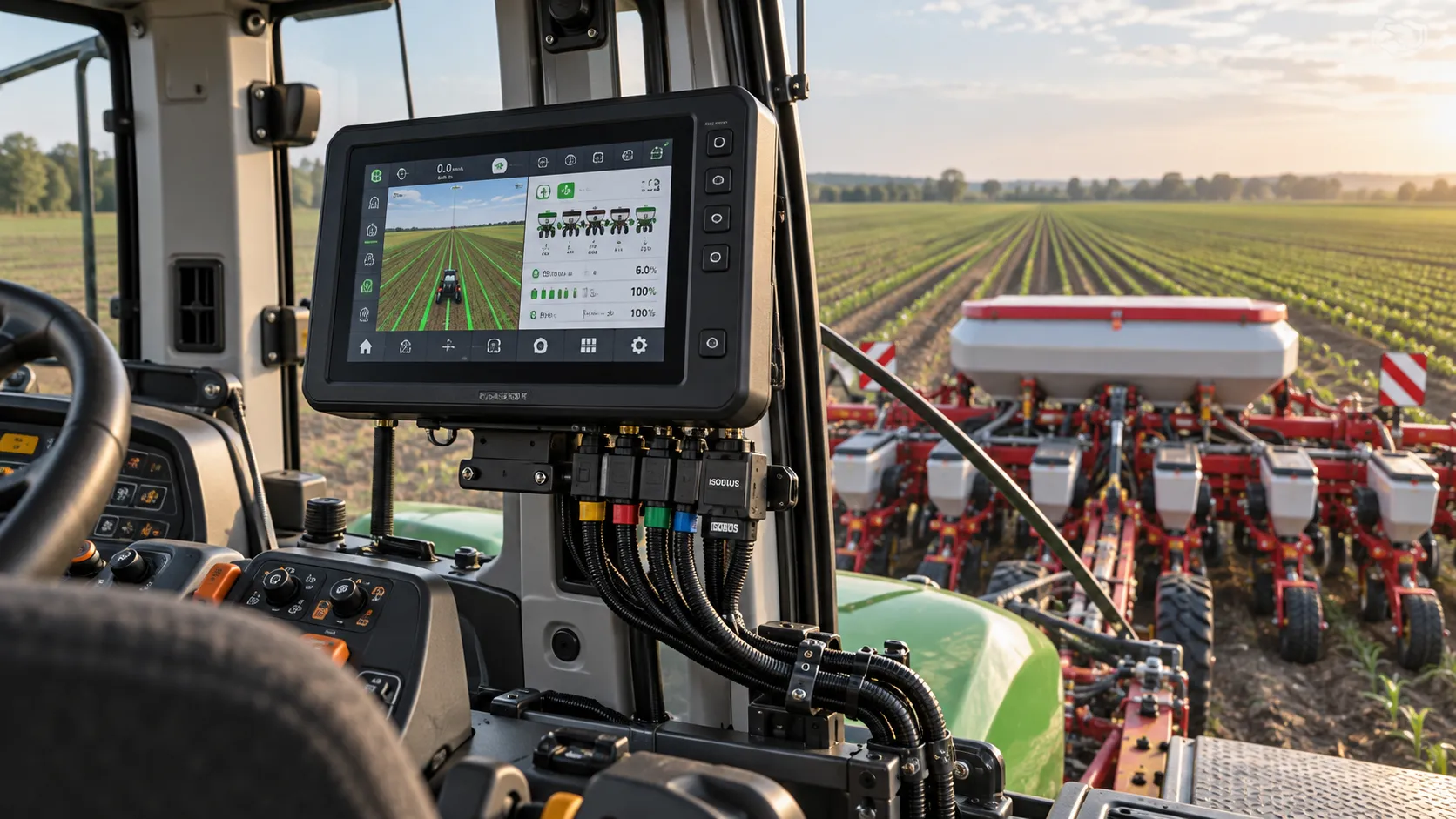
Choosing Precision Agriculture Controllers: ISOBUS and Variable-Rate Compatibility
Compare precision agriculture controllers for ISOBUS functionality, variable-rate compatibility, and data exchange. Discover what to test before buying to find the right fit for your fleet.
Choosing Drip Irrigation Systems for Open Fields: Soil, Slope, and Water Quality
Choose drip irrigation systems for open fields with confidence. Discover how soil, slope, and water quality shape emitter spacing, pressure, and filtration—and avoid costly design mistakes.
Choosing Crop Protection Equipment for Hot, Windy Middle Eastern Farms
Compare crop protection equipment Middle East farms need for hot, windy conditions. Discover key nozzle, drift-control, and durability checks to choose the right sprayer.
Choosing an Agriculture 4.0 Supplier: Compatibility, Support, and Total Cost
Choose an Agriculture 4.0 supplier with confidence. Learn how to verify compatibility, assess support, and compare total ownership costs to avoid hidden fees and costly downtime.
Low-Pressure Drip Irrigation: How to Fix Uneven Watering Without Raising Pressure
Optimize low pressure water-saving irrigation systems: discover how to fix uneven watering, clear blockages, and reduce hydraulic losses without raising supply pressure.
Comparing Farm Equipment Supplier Quotes: Price, Freight, and Warranty
Simplify supplier comparison for farm equipment price: assess freight, field-ready costs, and warranty coverage. Learn how to avoid hidden charges and choose a reliable supplier.
Choosing a Digital Farming Platform Provider: Compatibility and Data Ownership
Compare digital farming platforms providers on equipment compatibility, data ownership, and export rights. Discover practical checks to avoid lock-in and choose with confidence.
How Large-Scale Farm Telematics Cuts Downtime Across Mixed Fleets
Large-scale farm equipment telematics cuts mixed-fleet downtime with real-time alerts, smarter maintenance, and stronger operational control. Learn how to protect critical farm workflows.
How to Size Low-Pressure Water-Saving Irrigation Systems for Uneven Fields
Low pressure water-saving irrigation systems for uneven fields: learn zoning, pressure mapping, pipe sizing, and pump selection to improve uniformity and reduce water waste.
Related News
- 00
0000-00
Is GPS RTK precision agriculture accurate enough for row planting? - 00
0000-00
How an automatic guidance system reduces overlap during spraying - 00
0000-00
GPS-Guided Farm Machinery: Where It Delivers Measurable Field Efficiency Gains - 00
0000-00
ISOBUS for Smart Agriculture: How It Connects Tractors, Implements, and Farm Data - 00
0000-00
How North American Farms Can Select Crop Monitoring Systems by Acreage and Connectivity
Popular Tags
Tractor Power Architect
Weekly Insights
Stay ahead with our curated technology reports delivered every Monday.