
China-Kenya Weekly Rail-Sea Route Cuts Farm Machinery Transit to 18 Days
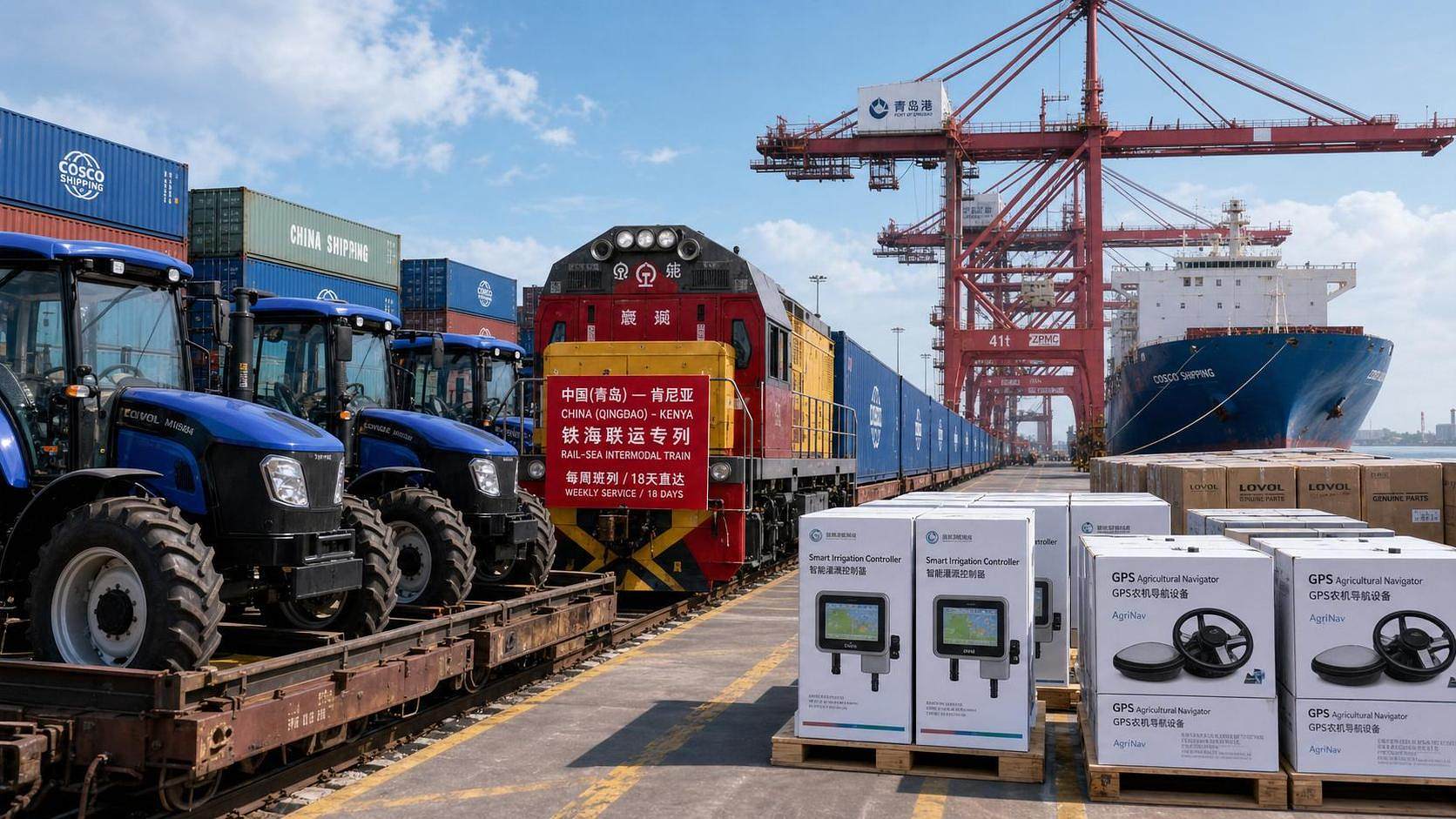




On June 22, 2026, Guangzhou Port Group and COSCO SHIPPING said the China-Kenya “Xiang-Guangdong-Africa” rail-sea corridor had been upgraded to a fixed weekly service. With cargo departing from Changsha or Hengyang and reaching Mombasa in no more than 18 days, the route draws attention from agricultural machinery exporters, component suppliers, distributors, and logistics providers because it shortens delivery time by 9 to 12 days versus traditional breakbulk and less-than-container-load arrangements and already covers complete machines and key parts bound for East Africa.
A scheduled corridor with defined transit performance
The confirmed update is that the corridor now operates as a regular once-a-week service rather than an ad hoc arrangement. According to the provided event summary, cargo moving from Changsha or Hengyang to Mombasa can maintain an end-to-end transit time within 18 days.
The information provided also states that this represents a reduction of 9 to 12 days compared with traditional breakbulk and consolidated shipping methods. The route already serves exports including tractors, smart irrigation controllers, GPS Guidance Systems, and related key components.
Within the scope of the provided information, the corridor is described as the fastest land-sea connection to the East African market.
Where the immediate business effects may appear
Exporters of complete agricultural machinery may gain tighter delivery control
From an industry perspective, companies shipping tractors and other complete units may be affected first because delivery promises, shipment batching, and dealer replenishment often depend on stable sailing and handover schedules. The main point to watch is not only the headline transit time, but whether weekly frequency improves planning for order cut-off dates and customer delivery commitments.
Component suppliers may see changes in shipment planning
Suppliers of smart irrigation controllers, GPS Guidance Systems, and other key parts may also be affected because a faster and more regular route can change how export lots are organized. What deserves closer attention is whether firms continue using mixed shipping arrangements or begin aligning production and outbound schedules to the weekly corridor.
Distributors and buyers in East Africa may focus more on replenishment rhythm
Analysis shows that downstream channels and procurement teams may pay closer attention to inventory timing when transit becomes more predictable. The practical impact is likely to appear in reorder planning, launch timing for imported equipment, and expectations around spare-part arrival windows rather than in immediate structural market changes.
Supply chain service providers face a higher requirement for coordination accuracy
Logistics companies, freight forwarders, and related service providers may be influenced through tighter coordination demands across inland rail, port handling, ocean transport, and destination delivery. The key change to monitor is whether the weekly service translates into more standardized operational windows for booking, documentation, and cargo handoff.
What companies should watch now
Distinguish fixed frequency from broad-based shipping certainty
Observably, the announced weekly schedule is a concrete operational signal, but companies should separate that from assumptions about all cargo conditions being equally simplified. For current business planning, firms should verify how their own product category, shipment size, and packaging format fit the corridor before revising customer promises.
Check whether product mix fits the route’s current use case
The provided information confirms coverage for tractors, smart irrigation controllers, GPS Guidance Systems, and key components. Companies shipping adjacent products should pay attention to whether their goods can be handled under the same operational pattern, especially when preparing sales offers, export plans, or delivery commitments tied to East Africa.
Strengthen document and handover discipline
With a fixed weekly departure model, missed documentation or late cargo handover may matter more than under less structured shipping arrangements. In practical terms, exporters and suppliers should closely manage paperwork readiness, internal cut-off coordination, and communication with customers about shipment windows and expected arrival timing.
Avoid overreading the headline speed advantage
Analysis shows that the 18-day transit figure is important, but businesses should treat it as a route-level capability described in the announcement rather than as a blanket guarantee for every shipment scenario. What deserves closer attention is how consistently this timing performs across actual export cycles and customer-facing orders.
Why this matters beyond a single schedule change
It is more appropriate to understand this as both a near-term operational update and a longer-term signal about route specialization for East Africa-bound agricultural equipment and related technology products. The immediate fact is the shift to weekly regularity and shorter transit time; the broader implication, as an observation, is that logistics reliability is becoming a more visible competitive factor for exporters serving the region.
At the same time, this should not yet be treated as a full market reshaping event. The information provided confirms route performance and product coverage, but it does not establish wider changes in demand, pricing, or trade structure. Continued observation is still necessary.
A practical way to read the development
In summary, this update is most significant as a logistics and delivery-timing development for China-to-East Africa agricultural equipment flows, especially for tractors, irrigation control products, and guidance-related systems or parts. The most balanced reading is that the corridor now offers a clearer and faster shipping option, while the broader commercial impact will depend on how exporters, suppliers, channels, and service providers adapt their planning and execution to the weekly service model.
Basis of this article and points for follow-up
This article is based on the user-provided news title, event date, and event summary. For developments of this type, commonly relevant source categories may include official announcements, corporate statements, industry association information, authoritative media reporting, and operational notices from logistics-related organizations.
A specific official source link was not provided in the input, so further verification remains necessary. If this topic continues to develop, the main follow-up points are whether the weekly service remains stable in practice, whether additional product categories begin using the corridor, and whether future official wording clarifies operating rules or service scope.
Related News

How to Select Precision Crop Protection Equipment for Variable Field Conditions
Precision crop protection equipment selection made simple: compare terrain, canopy, weather, control accuracy, and data workflows for reliable applications.

When Does Agricultural Machinery Leasing Cost Less Than Owning Equipment?
Agricultural machinery leasing can lower farm costs when use is seasonal or uncertain. Compare utilization, maintenance, cash flow, and risk to make a smarter equipment decision.

How to Evaluate Precision Fertilization System Suppliers for Farm-Scale Deployment
Precision fertilization systems suppliers: learn how to compare accuracy, integration, uptime, service, and total cost for confident farm-scale deployment.

ISOBUS for Smart Agriculture: How It Connects Tractors, Implements, and Farm Data
ISOBUS for smart agriculture connects tractors, implements, terminals, and farm data—helping growers improve precision, documentation, and smarter field decisions.

Automated Water-Saving Irrigation: How to Cut Water Use Without Reducing Crop Yields
Automated water-saving irrigation helps farms cut water use, protect crop yields, improve scheduling, and gain reliable control with sensors, flow monitoring, and smart zones.

Selecting Grain Farm Equipment by Acreage, Crop Mix, and Harvest Window
Agricultural equipment selection for grain farming: match machinery to acreage, crop mix, and harvest windows to improve uptime, efficiency, and returns.

Poultry Equipment Selection: Evaluating Durability, Cleaning, and Compatibility
Poultry equipments selection guide: evaluate durability, cleaning access, and system compatibility to improve hygiene, reduce downtime, and support efficient flock management.

How to Select Heavy-Duty Farm Implements for High-Acreage, High-Horsepower Operations
Heavy duty farm implements: learn how to match draft, hydraulics, hitch capacity, frame strength, and field conditions for reliable high-acreage performance.

Smart Farming Technology for Dairy Farms: Where Automation Delivers Measurable ROI
Smart farming technology for dairy farms delivers measurable ROI through automation, precision feeding, health monitoring, and data-driven cost control.
Related News
- 00
0000-00
ISOBUS for Smart Agriculture: How It Connects Tractors, Implements, and Farm Data - 00
0000-00
How North American Farms Can Select Crop Monitoring Systems by Acreage and Connectivity - 00
0000-00
How Tractor Intelligence Systems Improve Field Efficiency and Input Accuracy - 00
0000-00
Which equipment for larger fields maintains accuracy at higher speeds? - 00
0000-00
What should a digital ag platform integrate before a farm-wide rollout?
Popular Tags
Tractor Power Architect
Weekly Insights
Stay ahead with our curated technology reports delivered every Monday.