
How Smart Sprayers Adjust Application Rates Across a Field
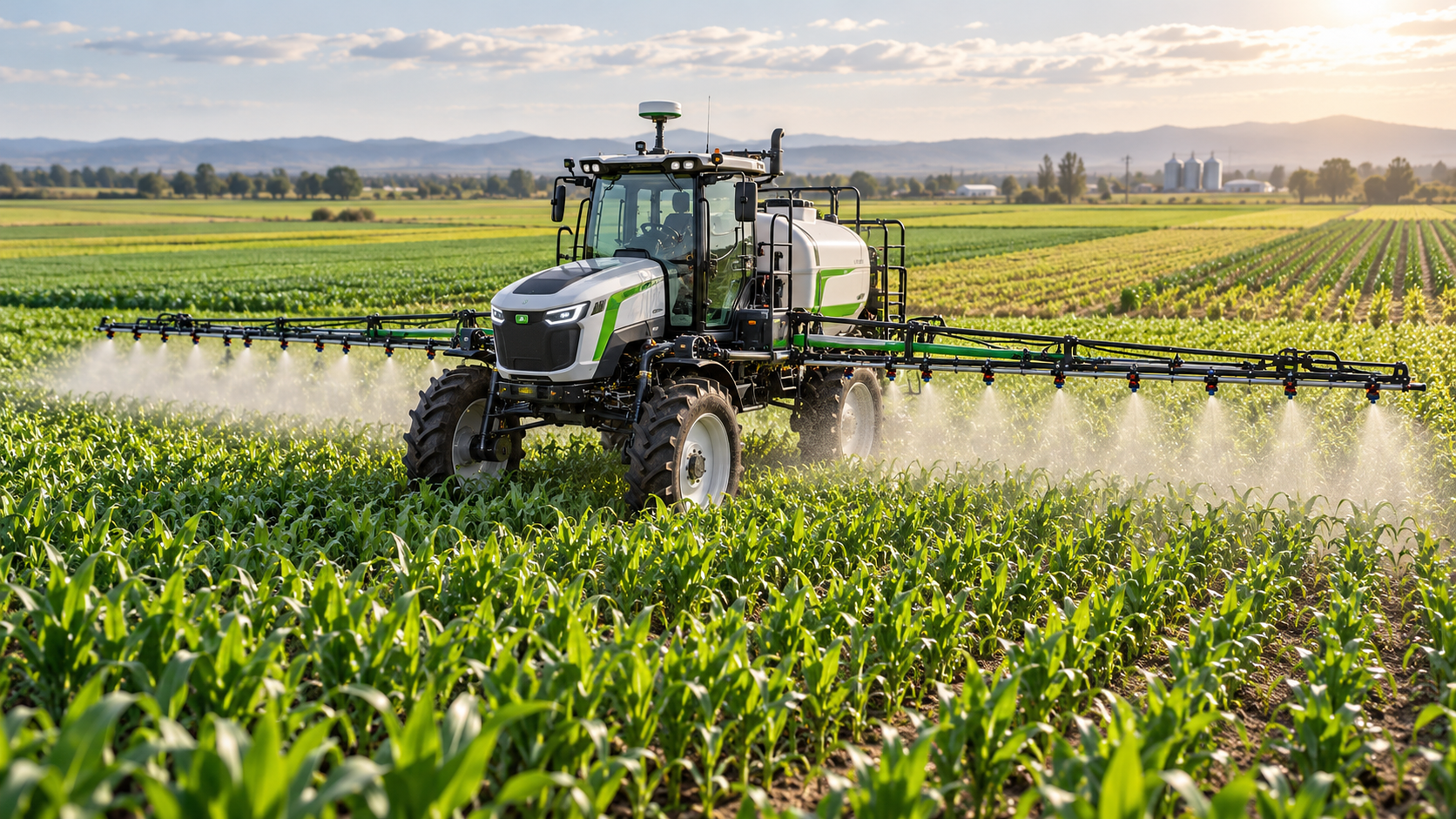




Smart sprayers adjust application rates by translating a location-specific target into changes in liquid flow or nozzle output. The target may come from a prescription map, a camera or another sensor; GPS or another positioning system helps the machine associate that target with the correct part of the field. A controller then uses speed, flow and equipment settings to regulate delivery.
The distinction between a requested rate and an achieved rate matters. A display can show that a prescription has changed, but the sprayer still needs enough hydraulic capacity, suitable nozzles and sufficient response time to deliver that change at the intended location. Useful agricultural machinery intelligence for sprayers therefore examines the complete chain, from the quality of the field data to the spray reaching the target.
From field variability to a spray command
A variable-rate system needs a reason to change its output. In map-based spraying, that reason is recorded in a prescription file before the machine enters the field. The file divides the field into zones or a grid, with a target rate assigned to each area. The prescription might reflect a weed survey, crop measurements or another agronomic assessment, provided those inputs support a defensible treatment decision.
As the sprayer moves, its controller compares the machine’s position with the prescription and selects the rate for the corresponding area. The controller must also account for the location of the boom and the delay between issuing a command and delivering spray. A rate change triggered at the wrong position can shift treatment across a zone boundary even when the selected rate itself is correct.
Real-time sensing takes a different route. A camera or other sensor observes the crop or ground during the pass, and software converts the observation into a treatment decision. Depending on the system, that decision may be a change in application rate, an on-or-off command for individual nozzles, or both. The sensor’s field of view, mounting position, detection capability and processing delay all affect where spray is applied.
Some systems combine the two approaches: a map supplies a baseline or operating zones while sensors adjust delivery within those limits. This can be useful when an existing prescription captures broad field differences but conditions change before spraying. It also adds dependencies: an unreliable map, unsuitable detection settings or a poorly configured control hierarchy can each undermine the result.
How the controller changes the rate
For a broadcast sprayer, application rate is normally expressed as volume per unit area. To maintain that rate as travel speed changes, the controller must change flow: covering more area per minute requires more liquid per minute. To apply a variable prescription, it must also increase or decrease flow when the target rate changes, even if speed remains constant.
A basic control loop receives the target rate and travel speed, measures flow, and adjusts a valve or pump control to bring measured output toward the target. The controller also needs to know the effective spraying width. If boom sections switch off to avoid an overlap, the active width becomes smaller and the required total flow changes with it.
Pressure-based control can change nozzle flow, but it has a practical operating range. As pressure changes, droplet characteristics and spray patterns can change too. A system that reaches the requested volume by pushing pressure outside the nozzle’s recommended range may sacrifice coverage or increase drift risk. Evaluating rate control therefore requires checking both volume delivery and the conditions under which that volume is produced.
Pulse-width modulation offers another control method on compatible sprayers. It rapidly opens and closes valves at the nozzles, changing the proportion of time they are open to adjust average output. Depending on the system, this can provide a wider flow adjustment range while keeping pressure more stable. It does not eliminate nozzle limits: nozzle selection, minimum and maximum flow, pressure, droplet quality and manufacturer-supported settings still determine the usable operating window.
Section control is not the same as variable-rate control
Section control turns groups of nozzles off and on, usually to reduce application outside a boundary or over an already treated area. Variable-rate control changes the target amount applied per unit area. A machine may have one capability without the other, or combine both.
Individual nozzle control can make the treated pattern more precise than large boom sections, particularly around irregular edges. It does not automatically mean that every nozzle can apply an independently prescribed rate. The distinction matters when comparing systems advertised as precision or spot-spraying equipment.
What determines whether the rate change lands in the right place?
Position accuracy is only one part of spatial accuracy. The machine must know where each controlled part of the boom is relative to its positioning antenna. Incorrect boom width, section layout or antenna offsets can move the recorded or applied pattern away from the intended area. Position corrections can improve guidance performance, but they cannot compensate for wrong geometry settings or an incorrectly located field boundary.
Latency is equally important. A map-based command passes through software, electronics, valves, hoses and nozzles before the new output reaches the target. A sensor-based system also has a distance between the sensor and nozzle, plus image processing and actuation delays. Ground speed determines how much distance the sprayer travels during those delays, so a timing setting that works at one speed may not work across the entire operating range.
At a boundary between two prescription zones, a slow response can produce a transition band rather than an immediate change. Small zones may be especially difficult if the sprayer cannot settle at the requested flow before entering the next zone. For spot spraying, the equivalent problem is missing part of a detected target or applying liquid beyond it. Ask how the system handles speed changes and whether timing can be calibrated for the actual installation.
Boom movement and turns introduce additional variation. During a turn, the outside of the boom travels faster than the inside. Without appropriate compensation, equal nozzle output across the boom can produce different application rates along the two paths. Boom height and stability also affect overlap and coverage, regardless of how accurately the controller reports total flow.
Prescription maps and sensors solve different problems
A prescription map is a good fit when the intended treatment can be determined in advance and the field information is current enough for the operation. It gives the operator an opportunity to review zones and rates before spraying, and it can incorporate agronomic information that an on-machine sensor cannot directly see. Its limitation is that it represents a decision made before the pass; it does not automatically detect a new weed patch or a change in crop condition.
Real-time sensing is useful when the target is visible and detection during the pass is more informative than an older map. Its performance depends on the target, background and operating conditions. A camera system designed to distinguish green vegetation from bare soil, for example, should not be assumed to identify weeds reliably within a green crop. Lighting, residue, dust, crop growth stage and sensor setup may also affect detection.
Detection and treatment are separate questions. A sensor may identify vegetation accurately yet still need an agronomically appropriate rule for deciding when and how to spray. Likewise, applying less liquid is not inherently a valid objective if it produces insufficient coverage or conflicts with the product label. Variable application must remain within the permitted use conditions for the product and the intended pest or crop treatment.
Check the operating envelope before comparing claims
The useful rate range is the range the complete machine can deliver at the intended speeds while maintaining acceptable spray quality. It is not simply the range that can be entered on the terminal. A low prescribed rate at high speed may require different nozzle behavior from the same rate at low speed; a high rate across the full boom may exceed available pump or plumbing capacity.
For an equipment assessment, define representative field conditions and ask the supplier to show how the proposed configuration handles them:
- Rate and speed range: Identify the lowest and highest intended rates, normal travel speeds and expected speed changes. Check whether those combinations fit the pump, plumbing, controls and nozzle operating ranges.
- Control resolution: Establish whether commands apply to the whole boom, sections, individual nozzles or another grouping. Match that resolution to the size and shape of the treatment zones or targets.
- Response and timing: Determine how changes are triggered, how delay is configured and how performance is assessed at zone boundaries, headlands and changing speeds.
- Spray quality: Review nozzle recommendations, pressure range, droplet requirements and coverage needs alongside the requested rate. A flow target alone does not describe the treatment deposited.
- Exceptions: Understand what happens when the requested rate cannot be achieved, positioning is lost, a sensor is obstructed or a prescription file cannot be read. Operator alerts and fallback behavior should be clear.
A machine that meets a rate requirement on a straight pass at steady speed may behave differently in small fields, on slopes or through frequent turns. Evaluation conditions should resemble the intended work, including the actual boom configuration and liquid properties where practical.
Integration and records: what the data can and cannot prove
Before relying on prescription files, check that the planning software and terminal exchange the required file format, coordinate information, rate units and field boundaries. An imported file is not necessarily a correctly interpreted file: a units mismatch, misplaced boundary or unsuitable default rate outside mapped zones can lead to an unintended application. A review on the terminal before starting the pass helps expose these problems.
Compatibility also extends to the tractor or sprayer electronics, display, sensors and rate controller. Support for a common communication interface can simplify integration, but it does not guarantee that every function, diagnostic or data field will work across manufacturers. Establish which components provide the prescription, speed signal, section status and application record, and who is responsible for configuring them.
An as-applied map is valuable for checking where the machine believed it sprayed and what rate it recorded. Its evidential value depends on the source of the data. A map based on commanded rates shows what the controller requested; a record using measured flow provides stronger evidence of total liquid delivery, but may still not prove the output of each nozzle or the coverage on the crop. Sensor detections, nozzle faults and actual deposition may require separate checks.
Commission the system around the intended job
Start with the agronomic decision: define what should change across the field, why it should change and the acceptable treatment range. Then select the sensing or mapping approach and confirm that the sprayer’s hardware can deliver the required rates at practical speeds. This order prevents a precise-looking interface from driving a treatment plan that the field data or machine cannot support.
Before routine use, check flow measurement, nozzle condition, boom geometry, section settings and timing. Run a controlled pass that includes a known rate transition and inspect both the machine response and the resulting record. Repeat checks when nozzles, boom configuration, major components or operating conditions change.
The strongest assessment connects the requested rate, the controller’s response and the physical spray pattern. When those agree under representative conditions, a variable-rate system can put a field-specific decision into practice. When they do not, the prescription or sensor output remains only a plan on a screen.
Related News
Agricultural Automation Still Needs Human Oversight, Study Finds
Agricultural automation still needs human oversight. Discover how AI and smart equipment are reshaping farm jobs, skills, and decisions.
Choosing a Precision Fertilization Equipment Manufacturer: What to Check
Choose a precision fertilization equipment manufacturer with confidence. Compare accuracy, compatibility, service and total ownership costs before you buy.
China's Autumn Grain Harvest Highlights Role of Machinery and Precision Farming
China's autumn grain harvest highlights machinery and precision farming. Explore how coordinated practices support harvesting and yield improvement.
Drip vs. Center Pivot Irrigation: Maintenance Tasks and Costs Compared
Use this irrigation solution comparison by maintenance to weigh drip vs. center pivot tasks, costs and downtime—and choose the best fit for your field.
EIMA 2026: Six Tractor of the Year Awards Include Autonomous Robot
Explore the Tractor of the Year awards at EIMA 2026, featuring six winners, including the AgXeed autonomous robot and leading tractor models.
Choosing Irrigation Systems for Government Projects: Water, Cost and Compliance
What factors affect irrigation system selection for government projects? Explore water supply, lifecycle costs and compliance to make a confident, well-informed choice.
Choosing an Agricultural Machinery Platform: Listings, Pricing, and Support
Choosing an agricultural machinery platform? Compare listings, pricing, supplier verification, and support to make a more confident equipment purchase.
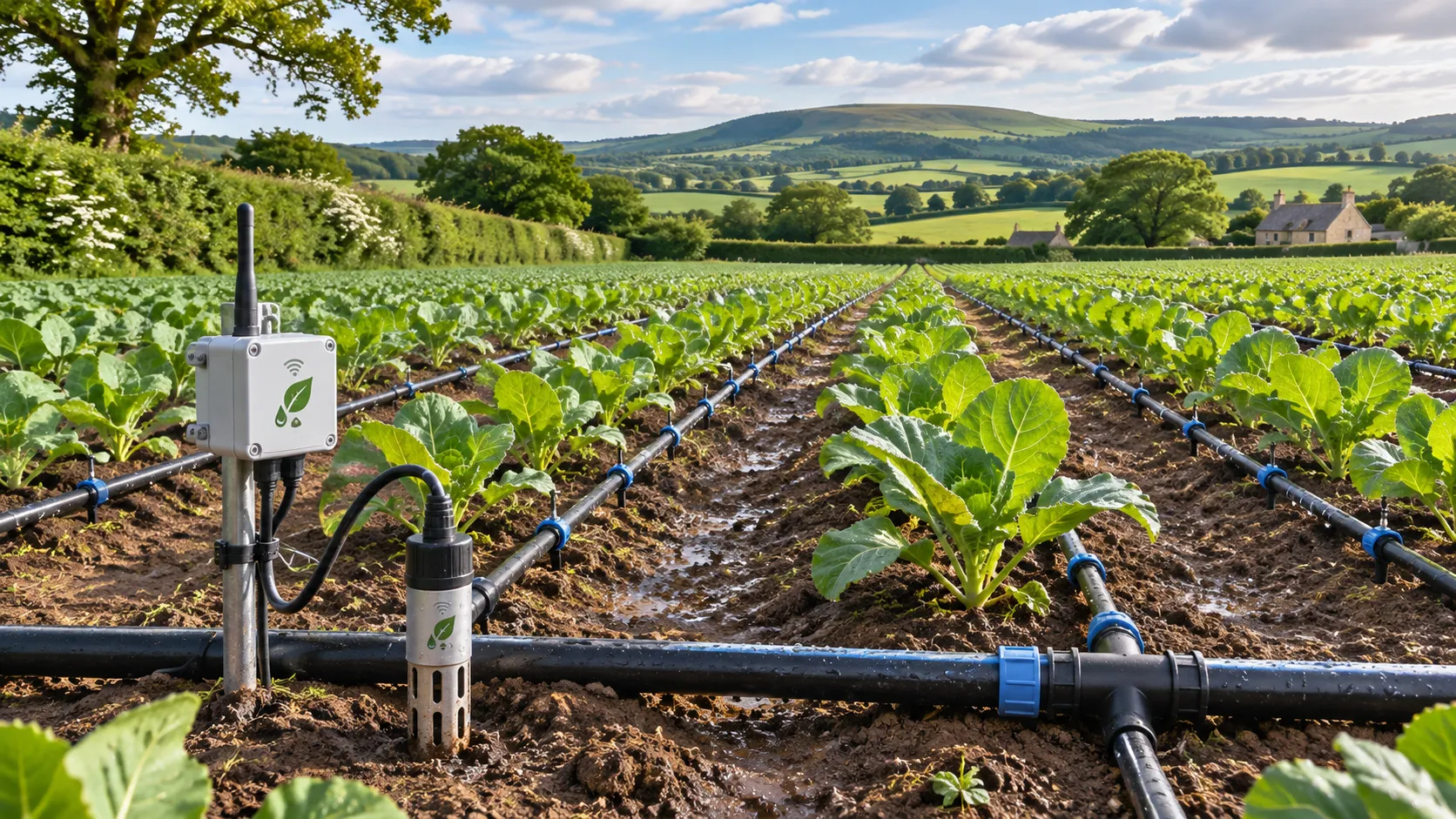
Ofwat Launches £8 Million Agri-Water Innovation Challenge
Ofwat’s £8 million Agri-Water Innovation Challenge supports smart irrigation, water reuse and water-saving solutions. Explore the funding and its potential impact.
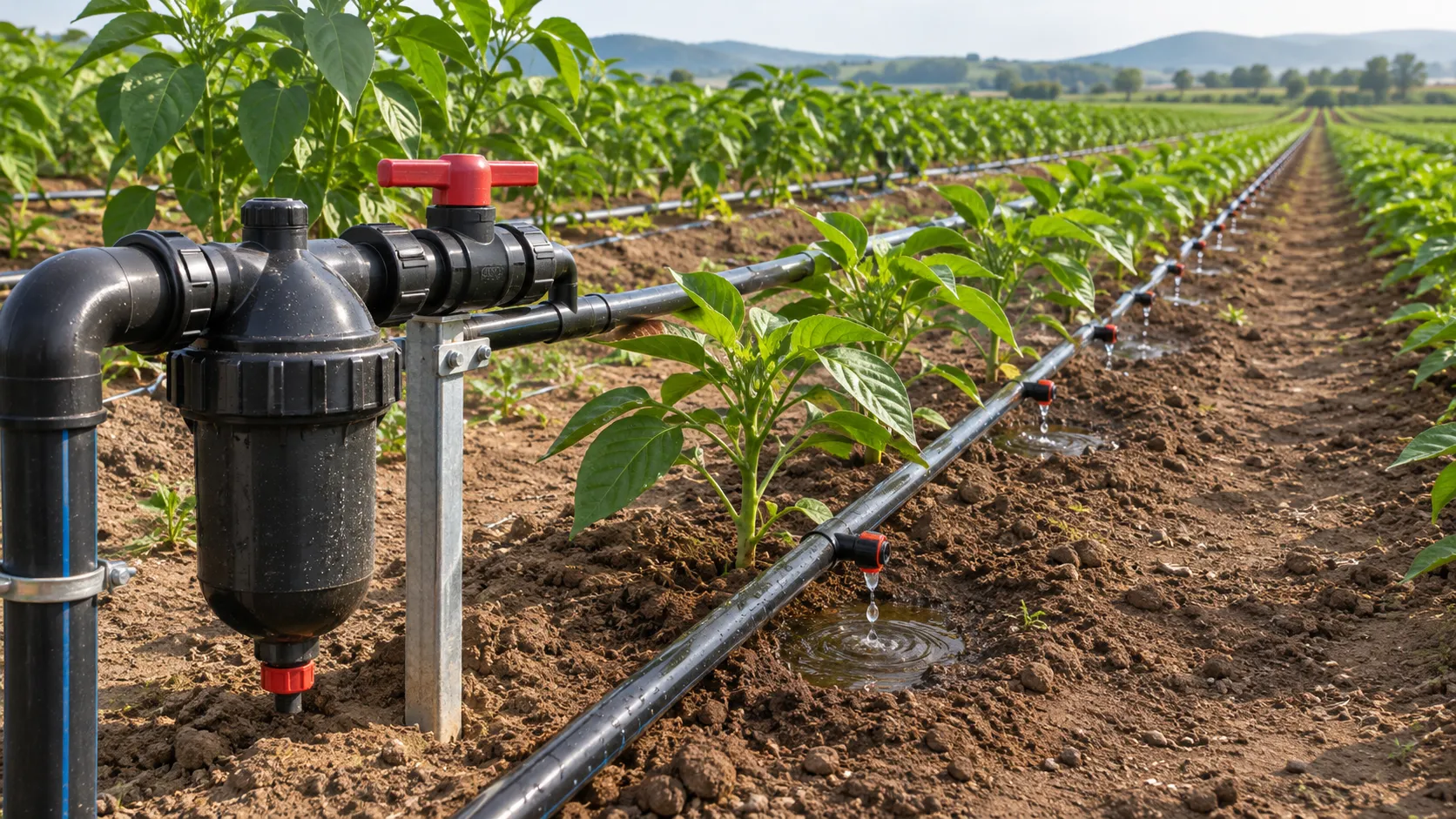
Choosing a Water-Saving Irrigation Supplier: 5 Key Procurement Criteria
Choose a water-saving irrigation systems supplier with confidence. Explore five procurement criteria to reduce risk and maximize long-term value.
Related News
- 00
0000-00
Choosing a Precision Fertilization Equipment Manufacturer: What to Check - 00
0000-00
How Smart Sprayers Adjust Application Rates Across a Field - 00
0000-00
Choosing Precision Agriculture Controllers: ISOBUS and Variable-Rate Compatibility - 00
0000-00
When digital crop monitoring detects stress before visible damage - 00
0000-00
How to Evaluate Dynamic Feedback Algorithm Suppliers for Precision Farming Systems
0000-00
Popular Tags
Tractor Power Architect
Weekly Insights
Stay ahead with our curated technology reports delivered every Monday.